Recourse vs Non-Recourse Loans in Real Estate: What Your Personal Guarantee Actually Covers
Almost every bridge loan, hard money loan, DSCR loan, and fix-and-flip loan from a private lender is full recourse. Non-recourse lending in real estate is a commercial product for large stabilized deals. Here is what your personal guarantee actually covers and when non-recourse applies.
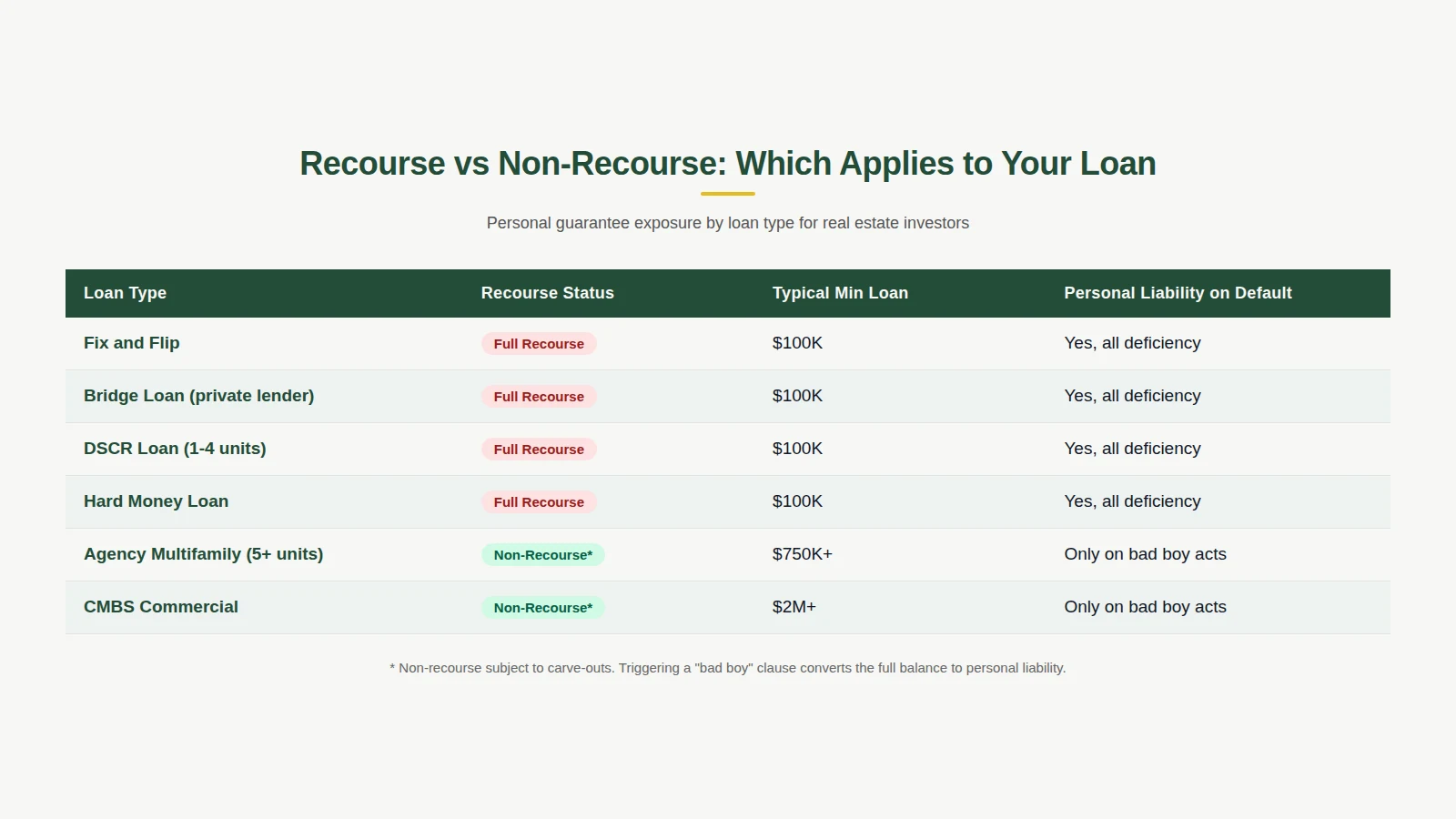
Almost every bridge loan, hard money loan, DSCR loan, and fix-and-flip loan from a private lender is full recourse. That means if the property sells for less than what you owe after a default, the lender can pursue your personal bank accounts, other assets, and wages for the difference. Non-recourse lending in real estate is a commercial product for large stabilized deals. If you are borrowing under $750,000 on a 1-4 unit property, non-recourse is not on the table regardless of which lender you use. This post is not for homeowners or anyone financing a primary residence.
What “recourse” means in your loan documents
A recourse loan includes a personal guarantee. When you sign one, you are agreeing that your liability is not limited to the property securing the loan. If you default and the lender forecloses, they can sell the collateral and then sue you for any remaining balance.
On a $350,000 bridge loan with a property that sells for $285,000 at foreclosure, that is a $65,000 deficiency. With a personal guarantee in place, the lender can file a deficiency judgment, attach bank accounts, garnish wages, or place liens on other property you own. Some states restrict deficiency judgments on certain loan types, but business-purpose investment property loans are exempt from most consumer protections. The protections that exist for a homeowner losing a primary residence generally do not apply here.
The personal guarantee is not buried in the fine print. It is usually a separate one-page document you sign at the closing table, alongside the promissory note. If you are unsure whether your existing loan carries a personal guarantee, look for a document titled “Guaranty” or “Personal Guarantee of Payment” in your closing package.
Where non-recourse lending actually exists
Non-recourse is primarily a commercial and agency product that applies at loan sizes well above what most individual investors use:
Agency multifamily loans (Fannie Mae and Freddie Mac): These are the most accessible non-recourse product for individual investors. They apply to stabilized properties with five or more units, loan sizes typically starting at $750,000 to $1,000,000, and DSCR requirements of 1.20 or higher at origination. If you own a 20-unit apartment building with a stable rent roll and you finance it through an agency channel, the loan documents are non-recourse. You still sign a carve-out guarantee, but the core loan does not carry personal liability for a standard default.
CMBS loans: Commercial Mortgage-Backed Securities loans on commercial property including retail, office, and multifamily at five-plus units are structured as non-recourse. Minimum loan sizes are typically $2,000,000 or higher. CMBS loans come with strict cash management requirements, reserve accounts, and limited flexibility to modify the loan once it has been securitized and sold to bond investors.
What is not non-recourse for most investors: Fix-and-flip loans, bridge loans under $5,000,000 from non-agency private lenders, DSCR loans on 1-4 unit properties, hard money loans, and portfolio loans on small residential properties. These are full recourse. If a lender’s marketing material says “non-recourse” and they are offering you a $300,000 loan on a single-family rental, read the guarantee document before you sign anything.
Want terms on a specific deal?Answer seven questions and get a decision in 72 hours.
Get FundingBad boy carve-outs: the clause that converts a non-recourse loan into a personal liability
Non-recourse loans are not unconditional. Every agency multifamily and CMBS loan includes what is commonly called a “bad boy” guarantee, also called a non-recourse carve-out or springing recourse clause. When a borrower triggers one of the named acts, the loan becomes fully recourse. Not just the deficiency amount. The full outstanding balance becomes a personal obligation.
Standard bad boy acts include:
- Fraud or material misrepresentation in the loan application or documents
- Intentional physical waste or damage to the property
- Misappropriation of rents collected after a default or notice of default
- Voluntary bankruptcy filing
- Failure to pay property taxes, allowing a tax lien to prime the first mortgage
- Failure to maintain required property insurance
- Transfer of ownership without lender consent, including partial transfers to new partners
- Environmental contamination of the property
The transfer carve-out catches investors more often than the others. Adding a new partner by transferring a small ownership interest to their LLC, done without reading the loan documents, can convert a $3,000,000 non-recourse loan into a full personal liability. If you are on a non-recourse loan and want to change the ownership structure for tax or estate reasons, talk to the loan servicer before you file anything with the county recorder.
The math on a triggered carve-out is worth understanding. On a $3,000,000 non-recourse loan where the property is worth $2,500,000 at default, a standard deficiency would be $500,000. If a bad boy act converted the loan to full recourse, your personal liability is $3,000,000. That is the gap between a painful loss and a catastrophic one.

What non-recourse lending actually costs
The rate premium on a non-recourse loan versus a comparable recourse loan is typically 20 to 50 basis points on stabilized multifamily. That spread sounds small. The more significant cost is in the LTV constraints.
Agency non-recourse loans on stabilized multifamily generally max out at 65-75% LTV depending on DSCR, property type, and market. CMBS can be more conservative, often 55-65%. Full recourse bridge and hard money loans from private lenders frequently go to 70-80% of purchase price or stabilized value, because the lender’s risk is partially transferred to you through the personal guarantee.
On a $1,500,000 stabilized apartment building, the difference plays out like this:
- 75% LTV agency non-recourse: $1,125,000 in financing, $375,000 in equity at close
- 80% LTV recourse bridge or DSCR: $1,200,000 in financing, $300,000 in equity at close
Non-recourse protects your personal balance sheet. It costs you leverage. For investors early in building a portfolio, the difference between $300,000 and $375,000 in cash required can determine whether a deal closes at all. For investors with significant personal net worth to protect, the tradeoff calculates differently.
How this affects actual loan decisions
Borrowing under $500,000: Non-recourse is off the table regardless of property type. Accept the personal guarantee, focus on how the deal performs, and understand your maximum deficiency exposure before you close. If the property’s value declines 20% from your basis, what does the deficiency look like? That is the number to know.
Owning a stabilized 5-10 unit building: Agency non-recourse financing is worth evaluating once the property has 90-day occupancy stability and a consistent rent roll. The DSCR calculator will tell you whether the income qualifies at the LTV you need before you spend time on an application.
Using a bridge loan to stabilize a value-add multifamily: Expect full recourse from your bridge lender during the stabilization phase. The exit into agency non-recourse financing is part of the two-phase strategy, but the bridge phase carries personal liability. That is the tradeoff for the speed and flexibility a bridge loan provides. See our earlier post on what a personal guarantee still costs you even when the borrowing entity is an LLC.
Reading any term sheet: The word “non-recourse” in a lender’s pitch email does not bind them. Look for the guarantee document, usually titled “Guaranty of Payment” or “Recourse Carve-Out Guaranty.” If there is a full personal guarantee, the loan is recourse regardless of what the email said. The post on reading a term sheet line by line covers how to identify guarantee language alongside the other terms that determine what a loan actually costs.
When non-recourse is the wrong structure for your deal
Non-recourse is wrong if:
- Your property is 1-4 units: No agency or CMBS lender will touch it. You will carry a personal guarantee regardless of lender.
- The asset is not stabilized: Agency and CMBS require 90-plus days of occupancy history and a consistent rent roll. A value-add deal at 60% occupancy does not qualify until it is stabilized.
- You need speed: Agency loans take 45 to 90 days to close. If your deal requires 10 to 15 business day funding, you are using recourse private lending by necessity.
- You have a short planned hold: CMBS loans carry yield maintenance or defeasance prepayment penalties. Selling or refinancing in year 2 or 3 is very expensive. These products are structured for long-hold investors.
- You need flexibility post-close: CMBS loans are securitized and difficult to modify. Cash management requirements, reserve accounts, and trigger events are strictly enforced. If you think you might need to add a partner, adjust the ownership structure, or sell a piece of the asset, recourse private bridge financing preserves options that CMBS removes.
What it costs when the deal slips: A recourse loan is not automatically catastrophic. If you have properly underwritten your exit, the property sells above the loan balance and the guarantee is never called. The risk becomes real when deal assumptions break: ARV comes in short, the market softens, or a rehab runs over budget and over time. The hard money loan program page outlines the standard underwriting criteria lenders apply, which gives you a framework for thinking through how much personal exposure a deal can carry before the numbers stop making sense.
Call 917-842-9982 to discuss how recourse and guarantee terms apply to a specific deal you are evaluating.
Common questions
Are DSCR loans recourse or non-recourse?
DSCR loans from private lenders on 1-4 unit properties are almost always full recourse. You will sign a personal guarantee at closing. If you default and the property sells for less than the loan balance, the lender can pursue your personal assets for the deficiency. Agency non-recourse DSCR financing is available on stabilized properties with five or more units and loan sizes generally starting at $750,000, subject to occupancy and DSCR requirements.
What are “bad boy” carve-outs on a non-recourse loan?
A bad boy carve-out is a clause in an otherwise non-recourse loan that converts the full loan balance to a personal obligation if the borrower takes certain prohibited actions. Common triggers include fraud, misappropriation of rents collected after default, voluntary bankruptcy filing, failure to pay property taxes, unauthorized ownership transfers, and failure to maintain insurance. Triggering a bad boy act makes you personally liable for the full outstanding balance, not just the deficiency amount.
Can you get a non-recourse loan on a single-family rental?
No. Single-family rentals and 2-4 unit properties are outside the scope of agency and CMBS non-recourse lending. Agency products start at five units and require loans of at least $750,000. If you are financing a single-family or small multifamily rental, the loan will carry a personal guarantee regardless of which lender you work with.
What is the difference between a deficiency judgment and a bad boy carve-out?
A deficiency judgment applies on a recourse loan after foreclosure. If the property sells for less than what is owed, the lender can sue for the gap. A bad boy carve-out converts a non-recourse loan into a full recourse loan when the borrower triggers prohibited acts. The key difference: a bad boy carve-out triggers liability for the full loan balance, not just the gap between the sale price and what was owed.
Does borrowing in an LLC make my loan non-recourse?
No. Most private lenders require a personal guarantee from the principal even when the borrowing entity is an LLC. The only way to achieve non-recourse protection is through the loan terms themselves, specifically through agency or CMBS structures on qualifying properties. An LLC without a personal guarantee on the loan provides liability protection from lawsuits and operational claims against the property, but that is separate from whether the lender can pursue your personal assets on a default.
Ready to fund your next deal?
Approval within 72 hours. Close in 5 to 10 business days.
Get Funding Now