Hard Money Loan for Rental Property: When It Makes Sense and What the Exit Costs
A hard money loan on a rental property is an acquisition tool, not a hold strategy. Know the carry cost, model the DSCR refi exit, and understand when this financing path is wrong before you sign.
A hard money loan on a rental property is an acquisition tool, not a hold strategy. If the property qualifies for a DSCR loan today, use a DSCR loan. Hard money makes sense when the property cannot yet qualify for long-term financing: it needs work, it is vacant, or you need to close before DSCR underwriting can catch up to a competitive timeline. The exit is a refinance into DSCR or conventional, and you need to know the numbers for that exit before you sign the hard money note.
This loan type is for real estate investors acquiring business-purpose rental properties. If you are buying the home you plan to live in, business-purpose lenders cannot fund that transaction.
Why a rental property sometimes needs hard money
DSCR lenders approve on the rent the property generates against the payment it carries. Three situations break that model:
The property is in poor condition. A standard DSCR appraisal requires the property to be habitable. A vacant duplex with a deferred roof, non-functioning HVAC, or code violations will not support a market rent appraisal. Hard money lenders care about the as-is value and the exit value, not whether the property is currently rent-ready.
The property is vacant with no rent history. Some DSCR programs qualify on market rent comps, but others require a trailing lease or an active tenant at application. Hard money has no such requirement. The property can be vacant the day you close.
Speed. A competitive off-market deal closes in five to seven business days. DSCR underwriting includes a full appraisal, title, insurance, and income verification that typically runs ten to twenty business days at minimum. Hard money can close in the window where DSCR cannot.
How hard money underwriting works on a rental purchase
The mechanics are asset-based, the same as on a fix-and-flip, but the reference point shifts. On a flip, lenders look at ARV: the value after repairs. On a rental acquisition, they look at the as-is value, because the exit is a refinance at roughly what you paid plus any improvements, not a sale at a higher price.
Typical parameters observed in the market in late 2026:
| Parameter | Range | What moves it |
|---|---|---|
| LTV (purchase) | 60% to 70% of as-is value | Experience, property condition, market |
| Interest rate | 10% to 13% annually | Rate environment, lender, LTV, borrower experience |
| Term | 12 to 18 months | Lender program |
| Points | 1.5 to 3 | LTV, term, experience |
| Payment structure | Interest-only | Standard for short-term bridge |
These are market rate ranges as of October 2026, not a rate sheet. Your specific terms will depend on the property, your track record, and the lender. Call 917-842-9982 to discuss a specific deal.
On a rental acquisition, because you are buying rather than rehabbing on a draw schedule, interest accrues on the full loan balance from day one. That matters significantly for carry cost math, and it is where investors most often underestimate the total cost of this financing path. For more on how hard money underwriting works, see our guide to hard money loan requirements.
Want terms on a specific deal?Answer seven questions and get a decision in 72 hours.
Get FundingThe carry cost: what 12 months of hard money actually costs on a $300,000 rental
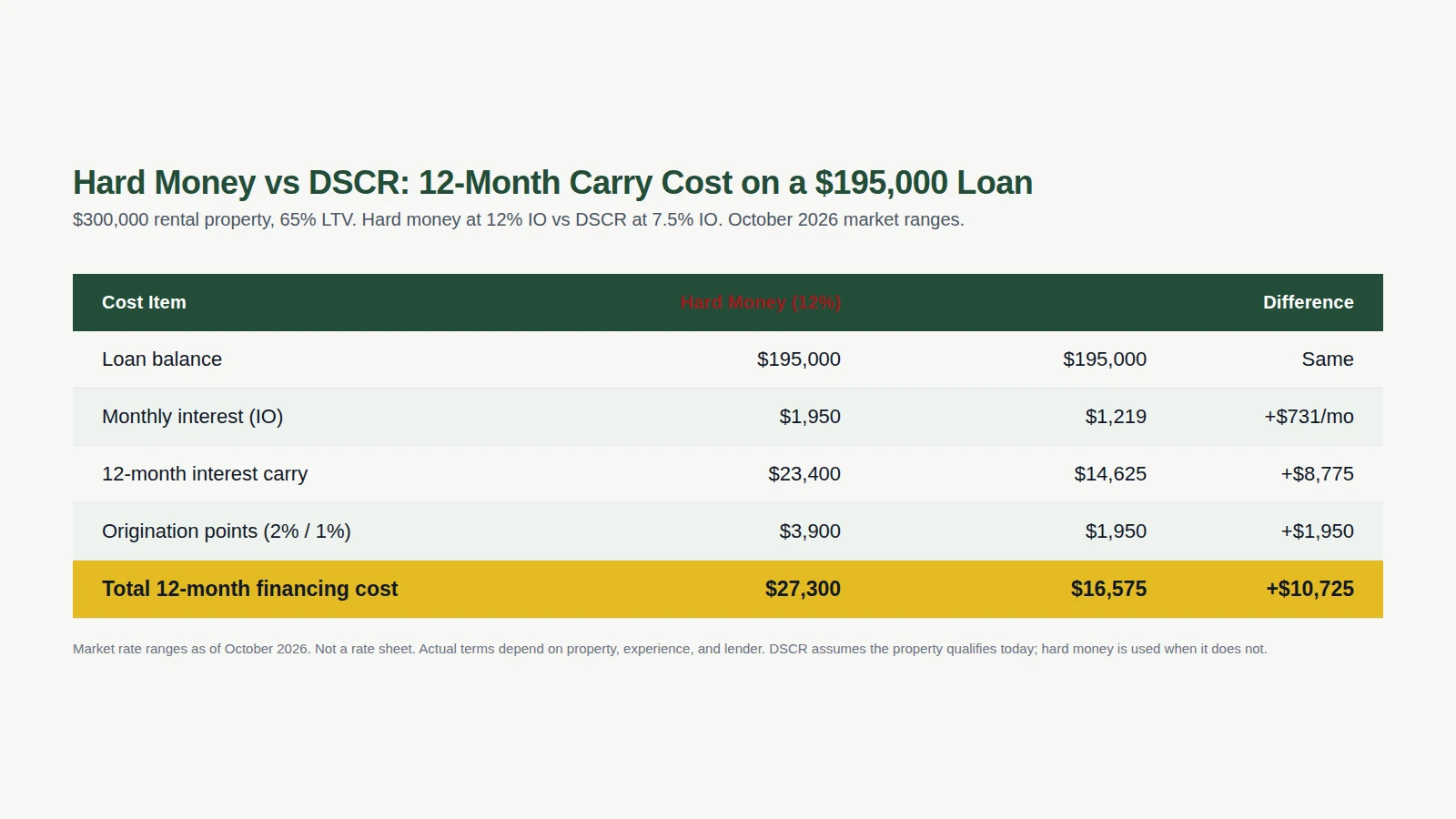
Take a $300,000 purchase. A 65% LTV hard money loan is $195,000. At 12% interest-only, the monthly payment is $1,950. Over 12 months, the interest carry alone is $23,400. Add 2 origination points at closing ($3,900) and the 12-month financing cost is $27,300, before title, insurance, property taxes, or any rehab.
Compare that to a DSCR loan at 7.5% on the same $195,000 balance: $1,219 per month, $14,625 over 12 months plus roughly $1,950 in points. Total 12-month financing cost: approximately $16,575. The spread is $10,725 per year.
That $10,725 is the cost of using hard money instead of DSCR. It is worth it if hard money is your only path to the deal. It is not worth it if the property already qualifies for DSCR today. Run the comparison at the hard money loan calculator before you commit to the acquisition. Model what the deal costs if it takes 18 months, not 12.
The exit: refinancing into a DSCR loan
The standard exit for a hard money rental is a DSCR refinance once the property is stabilized: rented, repaired, and seasoned enough to appraise at a value that supports the new loan. Three things determine whether that exit works.
Seasoning. Most DSCR lenders want at least three months of ownership before they will underwrite a rate-and-term refinance. Cash-out refinances typically require six to twelve months of seasoning. A rate-and-term refi (no cash out above your basis) usually has lighter requirements, sometimes as short as thirty to sixty days. The full breakdown is in our post on BRRRR refinance seasoning requirements, which covers the same rules that apply here.
Appraisal at refi. The DSCR lender orders a new appraisal at the time of the refinance. On a $300,000 property with $195,000 in hard money outstanding, an 80% LTV DSCR refi requires the property to appraise at $243,750 or better. Properties bought at a meaningful discount or improved before the refi usually satisfy this. Properties bought at full retail with no value-add work may not.
DSCR at the new payment. The DSCR lender runs the rent against the new, lower DSCR payment. If the property’s rent barely covered costs before, a higher balance at a lower rate may still produce a DSCR below 1.0. Model this at the DSCR calculator before you close the hard money loan, not after. Use the anticipated DSCR rate at refi, not the hard money rate, in that calculation.
When the exit fails
The extension fee is where a hard money rental gets expensive. If the refinance is not ready at month 12, most lenders offer a 3 to 6 month extension at 1% to 2% of the loan balance per extension period. On a $195,000 loan, a 1-point extension is $1,950. Two extensions add $3,900 to a loan already carrying at $1,950 per month.
Three failure modes that appear frequently:
Property appraises below expectation. The DSCR lender’s appraisal comes in at $230,000 instead of $265,000. At 80% LTV, the maximum DSCR loan is $184,000. You owe $195,000 on the hard money note. You either bring $11,000 cash to close the gap or extend the hard money note while you address the appraisal dispute or make additional improvements.
DSCR qualification falls short. Your tenant pays $1,800 per month. The principal and interest at 7.5% on $192,000 is roughly $1,342, and with taxes, insurance, and HOA, the full PITIA lands around $1,667. The DSCR is 1.08. That qualifies at many programs but sits below the pricing threshold where rates improve. A weaker rental market or higher tax assessment pushes this below 1.0 and the DSCR refi is unavailable entirely.
Vacancy at refi timing. Many DSCR programs require an active lease at application. If your tenant vacates at month 11, you may need to re-lease before the lender will fund, which means extending the hard money note through the re-leasing period.
Who this loan is wrong for
Hard money on a rental is the wrong financing tool in these situations:
- The property already qualifies for DSCR today. Use the DSCR rental loan program. The rate difference costs thousands per year for the same outcome.
- Your planned exit is to sell the property rather than hold it as a rental. Selling a tenanted rental at market value may not cover the hard money balance, points, and carry costs if you bought at or near market.
- You have no clear path to DSCR qualification. If the rent is thin relative to the market and the property needs more work than you have budgeted, the refinance may not pencil at any realistic timeline.
- You are unclear on the seasoning timeline. If a lender says a DSCR refi can happen in 30 days, verify whether it is rate-and-term or cash-out, what the LTV cap is, and whether they order their own appraisal.
- You are borrowing to hold long-term with no refi plan. Hard money is priced as a short-term bridge. Holding past 18 months on extensions at 1% to 2% per period is costly in a way that compounds quickly.
When the hard money rental strategy works, it works because speed and condition flexibility opened a deal that DSCR would have missed. The carry cost is real, the exit must be pre-modeled, and the refinance numbers need to work before you sign the acquisition note. See the full program details at our hard money loans page, or call 917-842-9982 to run the numbers on a specific property.
Common questions
Can you refinance a hard money loan on a rental into a DSCR loan?
Yes. Once the property is stabilized and meets the DSCR lender’s seasoning requirements, most programs will refinance a hard money note into a 30-year DSCR loan. Rate-and-term refinances typically require three months of ownership; cash-out refinances usually require six months or more. Model the DSCR qualification at the anticipated payment before you close the hard money loan, using the DSCR rate at refi, not the hard money rate.
What LTV can you get on a hard money loan for a rental property?
Most programs offer 60% to 70% of the property’s current as-is value for a stabilized or near-stabilized rental acquisition. If the property needs significant work, the lender may quote LTC (loan to cost) of 75% to 80% of the total project, still capped at 65% to 70% of ARV. The as-is LTV is typically the binding constraint on a buy-and-hold acquisition where you are not adding substantial value through renovation.
How does a hard money loan differ from a DSCR loan on a rental property?
Hard money is short-term bridge financing (12 to 18 months) based primarily on property value and the exit plan. DSCR is long-term rental financing (typically 30-year amortization) based on the property’s rent coverage ratio. Hard money gets you into a deal the property cannot qualify for today. DSCR is where you refinance once the property is stabilized and seasoned. They serve different phases of the same investment.
What happens if you cannot refinance out of a hard money loan on a rental?
The lender will typically offer a paid extension at 1% to 2% of the outstanding balance per extension period (usually 3 to 6 months each). Multiple extensions accumulate quickly on a loan that is already carrying at 10% to 13% interest. If the property cannot qualify for refinancing and extensions are exhausted, the lender may call the note due. This is why the DSCR refi analysis must be completed before the hard money loan closes.
Can you use hard money to buy a rental property with no money down?
Not through a standard business-purpose hard money program. Lenders typically require 30% to 40% equity at close, lending at 60% to 70% LTV. Some programs allow cross-collateralization against equity in another property to reduce the cash required at closing, but the equity requirement does not disappear. Claims of zero-down hard money in this space are typically attached to products with significantly higher rates, fees, or both.
Ready to fund your next deal?
Approval within 72 hours. Close in 5 to 10 business days.
Get Funding Now