DSCR Refinance: Rate-and-Term vs Cash-Out on a Rental You Already Own
A DSCR refinance replaces your rental property loan on the property's income, not your tax returns. Here is how rate-and-term and cash-out work, what each type costs, and the four situations where conventional financing beats DSCR.
A DSCR refinance replaces your rental property’s existing loan using the property’s income rather than your tax returns. If your W-2 shows nothing, or your returns are deliberately reduced through depreciation and entity deductions, DSCR is often the only path to a 30-year fixed product. If you qualify conventionally, conventional rates will usually price better, and this post is not for you. This is business-purpose financing that cannot be used on a primary residence.
Two types exist: rate-and-term, which pays off the old loan and possibly lowers your rate or monthly payment, and cash-out, which pays off the old loan and returns equity in cash. They price differently, cap differently on LTV, and carry different DSCR floors. Getting the two confused costs money.
How rate-and-term and cash-out differ on a DSCR refinance
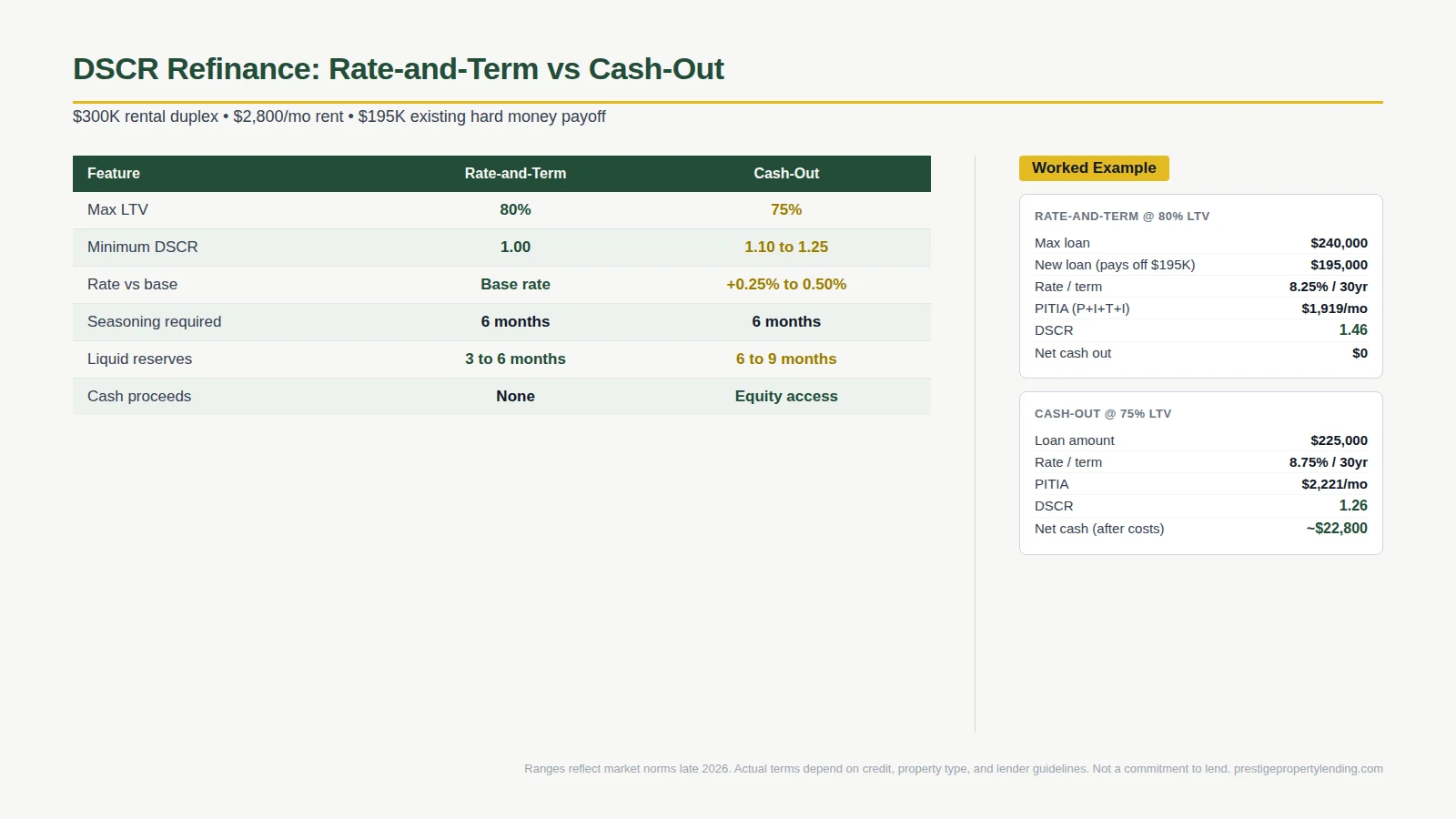
Rate-and-term refinances are limited to paying off the existing mortgage, closing costs, and minor escrow adjustments. No cash back beyond de minimis amounts (typically under $2,000). In exchange, you get higher LTV: most DSCR programs allow up to 80 percent on rate-and-term. The DSCR floor sits at 1.00 on most programs, meaning the property breaks even on paper.
Cash-out refinances let you pull equity. The LTV cap drops to 75 percent, sometimes 70 percent for properties under 12 months of ownership. The rate carries a premium of roughly 0.25 to 0.50 percent above rate-and-term pricing. The DSCR floor often rises to 1.10 or 1.25 depending on the lender, because they are extending more credit relative to property value and want a cushion. Reserve requirements go up as well.
| Feature | Rate-and-Term | Cash-Out |
|---|---|---|
| Max LTV | 80% | 75% |
| DSCR minimum (typical) | 1.00 | 1.10 to 1.25 |
| Rate vs base | Base rate | +0.25% to 0.50% |
| Seasoning required | 6 months (varies) | 6 months (varies) |
| Liquid reserves | 3 to 6 months PITIA | 6 to 9 months PITIA |
| Cash proceeds | None | Equity access |
These ranges reflect market norms as of late 2026. The specific numbers on your file depend on credit score, property type, and lender guidelines. Rates and LTV caps move with the broader market.
How lenders recalculate your DSCR at refinance
The DSCR on the new loan is calculated against the new payment, not the old one. This is where investors get caught.
Take a duplex worth $300,000 with $2,800 per month in combined rent. The existing hard money loan carries a $195,000 balance at 11 percent interest-only: the current payment is around $1,788 per month, and the DSCR looks healthy at 1.57. When you refinance into a 30-year amortizing DSCR product at 8.25 percent, the new P&I on $195,000 is $1,469 per month. Add property taxes ($325 per month) and insurance ($125 per month) and the PITIA comes to $1,919. DSCR on the new loan: $2,800 divided by $1,919 equals 1.46. Qualifies at most lenders, and the monthly payment dropped $131.
Now take the same property with a cash-out goal: the investor wants to pull equity and refinances at 75 percent LTV, which is $225,000. At 8.75 percent on 30 years, P&I is $1,771. PITIA: $2,221. DSCR: $2,800 divided by $2,221 equals 1.26. That clears most cash-out floors. Equity returned: $225,000 minus $195,000 payoff minus roughly $7,200 in closing costs, so about $22,800 net to the investor.
The trap is not the math itself, it is the appraisal. If the appraiser comes in at $270,000 instead of $300,000, the 75 percent LTV drops to $202,500. Subtract the $195,000 payoff and $7,200 in costs and the net cash out is $300. Not a typo. This is why BRRRR investors are told to verify the appraisal range conservatively before targeting a cash-out exit. The value you believe the property is worth and the value an appraiser will support using current comps are two different numbers.
Want terms on a specific deal?Answer seven questions and get a decision in 72 hours.
Get FundingSeasoning requirements and the BRRRR exit
Most DSCR lenders require six months of ownership before they will approve a cash-out refinance. Some require 12 months. The clock starts at the acquisition date, not the rehab completion date. A BRRRR investor who closed on a distressed property in February and finished the rehab in May is eligible for a cash-out refi in August, not in November.
A small number of lenders operate no-seasoning or delayed-financing cash-out programs, typically for properties purchased with cash. The LTV cap on no-seasoning programs is almost always lower, often 65 to 70 percent, and pricing carries an additional premium. They exist primarily for investors moving from a cash purchase to permanent financing, not as a standard BRRRR exit. If your acquisition relied on a hard money or bridge loan, expect to season six months before a cash-out closes.
Rate-and-term refinances carry fewer seasoning restrictions. A standard DSCR rate-and-term can often close as soon as the property is stabilized and rented, sometimes within 90 days of acquisition, because the LTV cap and the absence of cash back reduce lender exposure. Check the specific program: this is a common guideline, not a guarantee across all lenders or loan programs.
For a detailed breakdown of the 3, 6, and 12-month rules and which lenders apply which standard, see the post on BRRRR refinance seasoning requirements.
What a DSCR refinance actually costs
Closing costs on a DSCR refinance run roughly 2 to 4 percent of the loan amount, depending on state and lender. On a $225,000 loan in a typical state, budget $4,500 to $9,000: origination, appraisal, title, escrow, and recording. Origination is usually 1 to 2 points. Some lenders strip the origination point in exchange for a higher rate; others charge it explicitly on the closing disclosure.
The cost that catches investors unprepared is the prepayment penalty on the existing DSCR loan, if there is one. Most DSCR products carry a step-down prepayment penalty: 5 percent in year one, 4 percent in year two, stepping down to zero after five years in a common structure. Refinancing out of year two on a $225,000 DSCR loan triggers a $9,000 prepayment penalty. That does not appear on your lender estimate; it shows up at the title company when they pay off the existing lien. Verify the prepay structure on your current loan before you price out the refinance math. The savings from a rate drop can disappear quickly if the prepay on the existing note has not burned off.

Interest rate: DSCR refinance rates in late 2026 run in a range of roughly 7.50 to 9.50 percent on a 30-year fixed, depending on credit score, LTV, and DSCR ratio. Rate-and-term pricing sits at the lower end; cash-out adds 0.25 to 0.50 percent; credit scores between 640 and 680 add another 0.50 to 1.00 percent. These are ranges observed in the market, not a rate sheet. Lock the rate you are quoted for 30 to 45 days minimum: the market on a 30-year DSCR product moves faster than on an agency loan.
Before you order the appraisal, run the qualifying ratio at the rate you expect. The DSCR calculator takes the monthly rent and the expected PITIA and returns the ratio instantly. The appraisal is the only non-refundable step in the process. Run the math first.
When a DSCR refinance is the wrong choice
This loan is not the right answer for every investor refinancing a rental. Four situations where the math says no:
You qualify conventionally. If you have W-2 income, a clean tax return, and the debt-to-income ratio to pass Fannie Mae or Freddie Mac guidelines, a conventional investment property refinance will price 0.50 to 1.00 percent better than a DSCR product and carry no origination points in many cases. DSCR exists for investors who cannot document income the conventional way, not as a substitute for a loan you already qualify for.
Your rental income is trending down. A DSCR refinance qualifies on current rent, not projected rent. If your short-term rental sits at 40 percent occupancy this quarter because of platform changes or new supply in the market, the lender is qualifying on the income it sees today. Refinancing into a 30-year amortizing product with weakening income locks in a payment structure without locking in the income that supports it.
You need cash within 30 days. A DSCR cash-out refinance takes 30 to 45 business days in normal conditions, sometimes longer if the appraisal requires a desk review or the title search surfaces an issue. If the cash is needed for a time-sensitive acquisition, a bridge loan closes faster. The DSCR refi is a permanent capital structure decision, not a source of emergency liquidity.
Your prepayment penalty exceeds the benefit. Run the breakeven before you proceed. If the rate drop saves $180 per month but the prepay on the existing note is $9,000, the breakeven is 50 months. If your hold horizon is three years, refinancing costs money. The calculation is straightforward; many investors skip it because they see a lower rate and assume savings follow automatically.
For more on how DSCR rates are structured by tier and what credit score and LTV do to your pricing, see the DSCR loan rates guide. For the full loan structure, qualifying timeline, and what we fund, see the DSCR rental loan program page. Call 917-842-9982 with questions on a specific file.
Common questions
Can you refinance a DSCR loan into a conventional loan?
Yes, if you qualify under Fannie Mae or Freddie Mac guidelines. Conventional investment property loans require documented personal income, a qualifying debt-to-income ratio, and typically two years of landlord history on the Schedule E of your tax returns. If your income qualifies you conventionally, conventional pricing will usually beat DSCR pricing by 0.50 to 1.00 percent. DSCR and conventional refinances are not mutually exclusive; the question is which one you qualify for and which one prices better on your specific file.
Does the rental income have to be seasoned before it counts toward the DSCR?
Most lenders want a signed lease or a documented rental history, not a projected income figure. A lease with six to twelve months remaining and a record of on-time payments is the cleanest scenario. If the property is newly rented, some lenders will use an appraiser’s rental survey (market rent estimate), but market rent is not the same as collected rent. The DSCR your loan qualifies at is based on what the lender will credit, which can be lower than your actual rent if the documentation is thin.
What happens if the appraisal comes in below what I expected?
The LTV cap applies to the appraised value, not the value you believed the property was worth. If you targeted a cash-out at 75 percent of $300,000 and the appraisal comes in at $270,000, your maximum loan is $202,500. Subtract a $195,000 payoff and $7,000 in costs and the net proceeds are $500. You can challenge the appraisal with comparable sales data your agent or broker provides, but the lender’s appraisal review department controls the outcome. The appraisal is the only non-refundable cost in the process: verify your comps before you order it, not after.
Can a DSCR refinance close in an LLC?
Yes. Most DSCR lenders are comfortable with single-member LLCs and many accept multi-member LLCs with a personal guarantee from the managing member. Vesting in an LLC does not disqualify the loan. You will need the LLC operating agreement, articles of organization, and evidence of the managing member’s authority to execute loan documents. Consult a real estate attorney before changing title on a property you intend to refinance: a title transfer after an existing loan closes may trigger the due-on-sale clause in that loan.
Is there a minimum loan amount for a DSCR refinance?
Most DSCR programs have a floor of $100,000. Some programs require $150,000 or more for cash-out refinances. Below those thresholds the fixed costs of origination and servicing consume the yield margin, and lenders decline to quote. Smaller loans on lower-value properties in secondary markets are the most common case where minimum loan amounts become a barrier to accessing DSCR financing.
Ready to fund your next deal?
Approval within 72 hours. Close in 5 to 10 business days.
Get Funding Now