DSCR Loan for a Condo: How HOA Dues and Warrantability Change What You Can Borrow
A DSCR loan can finance an investment condo, but the HOA dues go directly into the payment denominator, and the building itself goes through a warrantability review that can lower your maximum LTV by 5 to 10 points. Here is how to run the numbers before you go to contract.

A DSCR loan can finance an investment condo, but the approval has two layers most lenders do not lead with: the HOA dues change the qualifying calculation in a way that often surprises investors, and the building itself goes through a warrantability review that can reduce your maximum LTV by 5 to 10 points. If you are buying a condo to live in as a primary residence, this loan structure does not apply to you and cannot be used for that purpose. This post is for investors buying or refinancing a condo as a rental property.
How HOA dues change your DSCR
On a single-family rental, DSCR is gross monthly rent divided by PITIA: principal, interest, taxes, and insurance. On a condo, the denominator gains a fifth letter. The A stands for association dues, and they increase the payment your rental income has to cover.
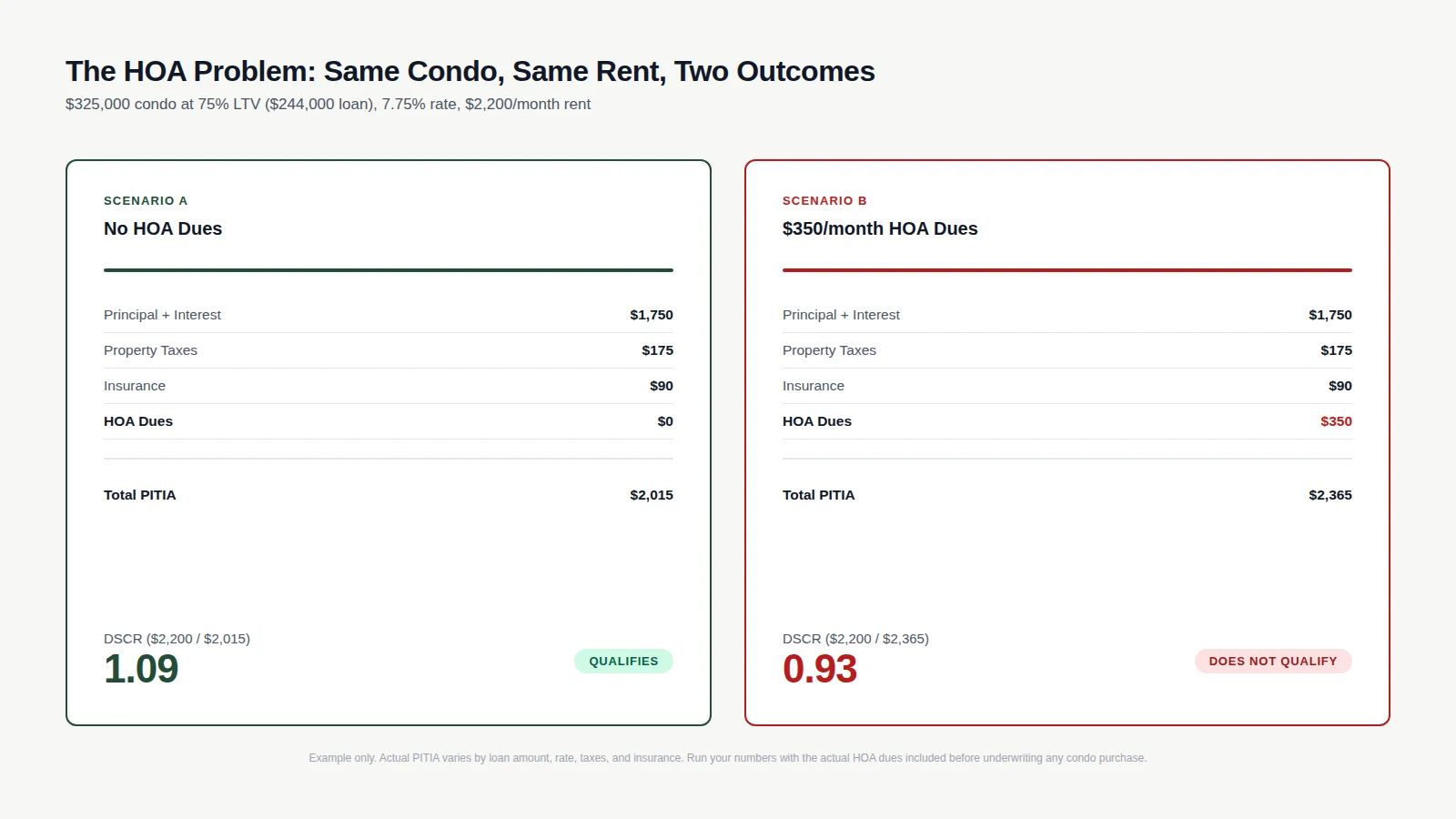
Here is what that does on a real deal. Say you are buying a $325,000 condo at 75% LTV, which puts your loan at $244,000. At a 7.75% note rate on a 30-year term, your P&I runs approximately $1,750 per month. Add $175 in property taxes and $90 in homeowners insurance, and your PITIA sits at $2,015. The unit rents for $2,200 per month. Your DSCR is $2,200 divided by $2,015, which is 1.09. That qualifies at nearly every lender.
Now add the HOA dues. The building charges $350 per month.
PITIA climbs to $2,365. Your DSCR drops to $2,200 divided by $2,365, which is 0.93. Most lenders require 1.0x minimum. The same property, same rent, same loan, same rate, different answer because a $350 monthly dues charge crossed the line.
Three responses exist when this happens. You can bring more cash down to lower the loan balance and therefore the P&I. You can target buildings with lower monthly fees. Or you can find a lender that accepts a 0.90x minimum DSCR with a larger down payment in exchange, though that path costs more in rate. The practical rule: add HOA dues to your payment estimate before you underwrite any condo purchase. Investors who run a rough DSCR without the dues see one number at underwriting and get a different number at application.
What warrantability means for your loan
Warrantability describes whether a condominium project meets the guidelines used by Fannie Mae and Freddie Mac. This matters for DSCR rental loans even though they are non-QM products, because most DSCR lenders use the same project review framework as a baseline for what they will and will not finance.
A warrantable condo gets standard underwriting: LTV up to 75 to 80% on an investment unit, standard credit requirements, no project-level premium.
A non-warrantable condo gets a more conservative structure: maximum LTV typically drops 5 to 10 points, reserve requirements increase, and the rate may carry a 0.25 to 0.75% premium over a comparable warrantable deal.
On that same $325,000 purchase:
| Scenario | Max LTV | Loan Amount | Cash at Close |
|---|---|---|---|
| Warrantable condo | 75% | $243,750 | $81,250 |
| Non-warrantable condo | 70% | $227,500 | $97,500 |
That is $16,250 more cash required at close, before the rate premium is factored in. If the non-warrantable path adds 0.50% to the rate, the monthly payment increases by roughly $70, which further compresses the DSCR that may already be tight because of the HOA dues.
Not every DSCR lender will touch non-warrantable condos. Some exclude them entirely. Others will consider them with enough equity and a clean project review. The question to ask any lender before spending time on a deal: what is your policy on non-warrantable projects?
Want terms on a specific deal?Answer seven questions and get a decision in 72 hours.
Get FundingWhat makes a condo non-warrantable
Any of these conditions can trigger a non-warrantable determination on the project review:
Investor concentration. When more than 50% of the units in the building are owned by investors rather than owner-occupants, the project fails the owner-occupancy test. This is common in urban high-rises and vacation markets. It does not automatically kill a DSCR deal, but it lowers your LTV ceiling.
HOA delinquency. When more than 10 to 15% of units are behind on dues, it signals that the HOA reserve fund may be underfunded. A poorly funded reserve means the next large repair could produce a special assessment against every unit owner, which is a risk lenders are not willing to absorb silently.
Active litigation. A lawsuit against the HOA, whether for construction defects, slip-and-fall liability, or any other claim, is a hard stop at many lenders. If the HOA loses a large judgment, every unit owner bears the cost through assessments or dues increases.
Master insurance gaps. The HOA’s master policy needs to cover the entire structure. If the coverage amount falls short of replacement cost, or if the deductible structure would create a gap in a major loss, lenders flag it.
Commercial space concentration. Buildings where commercial tenants occupy more than 35% of total square footage face scrutiny. Too much commercial exposure changes the risk profile of the building from residential to mixed-use.
Single-entity concentration. If one person or company owns more than 10 to 15% of the units, the building is considered concentration risk. A developer holding unsold units in a new project is the most common version of this condition.

The HOA questionnaire
Before a DSCR lender approves a condo deal, they send an HOA questionnaire to the condominium association. The HOA management company fills it out. It captures total units, owner-occupied versus investor-owned count, delinquency rate, pending litigation, insurance coverage, reserve fund balance, and whether rentals are permitted.
This form is not under your control. You cannot fill it out for them, and you cannot predict what it will say before they respond. The turnaround time is typically 7 to 14 days, which is a week of your rate lock burning down while you wait.
Two things you can do before going to contract: ask the HOA for a copy of their most recent reserve fund study and the last year of board meeting minutes. Litigation is disclosed in meeting minutes. Reserve fund shortfalls show up in the study. If either document looks problematic, you have learned before the questionnaire confirms the same thing on the lender’s clock.
The rental restriction trap
Some condominium associations restrict rentals. The restrictions range from outright bans to minimum lease terms to caps on how many units in the building can be rented at any one time.
An outright rental ban ends the investment thesis entirely. If the HOA documents prohibit leasing, there is no DSCR loan because there is no rental income to qualify against.
A minimum lease term of six or twelve months does not kill the loan, but it eliminates short-term rental income if that was part of the underwriting.
A rental cap, say 20% of units may be leased at a time, creates a waitlist. If that cap is currently at capacity, you cannot rent the unit until another owner exits the rental program. That is a purchase to walk away from.
The HOA documents, specifically the Declaration of Covenants, Conditions and Restrictions, contain the rental rules. Read them before going under contract, not after. The relevant provisions can be identified in a 30-minute attorney review.
When this loan is wrong for you
DSCR financing for condos works in the right building. It is the wrong tool in several situations worth naming plainly.
The HOA math does not work. If the DSCR with dues included falls below 1.0x and you cannot bring additional cash down to fix it, the deal is not financeable on these terms. Run the numbers including dues before you make an offer. Use the DSCR calculator with the PITIA field filled in accurately.
Active construction defect litigation. Buildings with ongoing lawsuits against the developer or HOA are declined by most DSCR lenders. If you are set on the building, the only paths are cash or a bridge loan with an exit plan tied to the litigation resolving. The timeline on construction defect cases is measured in years, not weeks.
Condotels. A condominium hotel, where units participate in a hotel rental pool managed by an operator, is not a standard DSCR product. Most non-QM lenders exclude condotels entirely. Those that will lend treat it as a commercial asset with different underwriting, not a residential DSCR.
New projects with low presale rates. A newly completed building where less than 90% of units are sold or under contract has not met the project stability threshold most lenders require. This is typically a temporary condition: once the building sells out, warrantability becomes achievable. Trying to finance during the lease-up phase is a harder path.
When the DSCR tier costs too much. A condo DSCR at 0.95x with a large down payment to compensate is not automatically a good deal. The rate premium from the DSCR tier, the LTV reduction from non-warrantable status, and the reduced cash-on-cash return from the higher equity requirement may make a different property type more efficient for the same capital. For a full picture of how DSCR is calculated and what moves each component, see our post on how DSCR is actually calculated.
Common questions
Do HOA dues go into the DSCR calculation?
Yes. On a condo, the DSCR denominator is PITIA: principal, interest, taxes, insurance, and association dues. A $350 monthly HOA fee is treated the same as $350 in taxes or insurance. It increases the payment your rental income has to cover, which is the most common reason a condo DSCR comes in lower than an investor expects when first running the numbers.
What makes a condo non-warrantable for DSCR purposes?
The most common triggers are investor concentration above 50% of units, HOA delinquency above 10 to 15%, active litigation against the HOA, master insurance gaps, and rental restrictions that prohibit leasing. Non-warrantable status does not automatically disqualify a condo from DSCR financing, but it typically lowers your maximum LTV by 5 to 10 points and may add a rate premium of 0.25 to 0.75%.
Can you get a DSCR loan on a condo hotel?
Most DSCR lenders exclude condotels, defined as units that participate in a hotel operator’s rental pool. The income is treated as hospitality revenue rather than standard residential rental income, and the project review framework does not fit a standard condo analysis. If condotel financing exists for a given property, it usually comes through commercial lending channels, not the DSCR product.
What is an HOA questionnaire and who fills it out?
An HOA questionnaire is a form the lender sends to the condominium association to gather project-level data: unit count, owner-occupancy ratio, delinquency rate, insurance coverage, reserve fund balance, pending litigation, and rental policy. The HOA management company completes it, not you. The typical response time is 7 to 14 days. Requesting the reserve fund study and the last year of meeting minutes before you go to contract can surface problems before the questionnaire confirms them on the lender’s clock.
What DSCR do you need to qualify on a condo?
The floor is typically 1.0x, meaning rent must at least cover the full PITIA payment including HOA dues. Better pricing starts around 1.20x, the same as a single-family rental. Because condos carry a larger denominator from HOA dues, a property that would comfortably qualify as a single-family rental can land at a 0.93 DSCR as a condo. Run your numbers with actual HOA dues before relying on any estimate.
To discuss a specific condo deal, call 917-842-9982.
Ready to fund your next deal?
Approval within 72 hours. Close in 5 to 10 business days.
Get Funding Now