DSCR Loans for Short-Term Rentals: How Lenders Actually Calculate Your Income
A DSCR loan on a short-term rental has no lease to underwrite. Lenders use three different income methods: AirDNA projections, trailing 12-month booking statements, or long-term market rent equivalents. The method in play determines whether you qualify. Here is how each works, with worked numbers, and what changes at higher LTVs.
A DSCR loan on a short-term rental property works by the same basic logic as on a long-term rental: the property’s income has to cover the payment. The complication is that a short-term rental has no lease. The lender has to decide what your Airbnb, Vrbo, or vacation rental earns, and the method they choose to answer that question is the difference between qualifying and not qualifying. This post is for real estate investors buying or refinancing an income-producing short-term rental. If you are buying a vacation home you plan to occupy personally, these loans are not available to you.
Why short-term rental income is harder to underwrite
On a standard long-term rental, the DSCR calculation is simple: the signed lease rent divided by PITIA (principal, interest, taxes, insurance, and HOA dues). A $2,400 lease against a $2,050 monthly PITIA produces a 1.17 DSCR. Every lender reads the same document and arrives at the same number.
A short-term rental has no lease. It has a nightly rate, a seasonal booking pattern, platform fees that come off the top, and an occupancy history that may not exist yet if you are acquiring the property. The lender cannot use a signed document. They have to estimate income, and there are three different methods for doing that. Lenders do not all use the same one, and it matters more than any other variable in the underwriting.
The three income methods, with worked numbers
Take a $450,000 coastal vacation rental. The loan is $337,500 at 75 percent LTV, producing a $3,100 monthly PITIA. AirDNA projects $5,200 per month in gross revenue. The long-term market rent equivalent in the same area is $2,400 per month, because long-term lease rents are low relative to the vacation short-term market.
Method 1: AirDNA projection with a haircut. AirDNA models projected gross STR revenue from comparable properties in the market. Most lenders who accept this method apply a factor of 70 to 80 percent to account for vacancy, platform fees (typically 3 to 5 percent on Airbnb, more with full-service management), and income volatility. At 75 percent, the $5,200 projection becomes $3,900 of qualifying income. DSCR: $3,900 divided by $3,100 equals 1.26. Qualifies.
Method 2: Trailing 12-month actual bookings. If you have owned and operated the property for at least 12 months, some lenders will use your platform statements. The same 75 to 80 percent factor applies to net out fees and vacancy. If the property grossed $57,600 over the prior year, that averages $4,800 per month; at 80 percent, qualifying income is $3,840. DSCR: $3,840 divided by $3,100 equals 1.24. Qualifies, and typically at slightly better pricing than a projection-only file because the income is documented rather than modeled.
Method 3: Long-term market rent equivalent. The most conservative approach: the lender ignores the STR income entirely and qualifies the property on what it would rent for under a standard 12-month lease. On this property, that is $2,400. DSCR: $2,400 divided by $3,100 equals 0.77. Does not qualify.
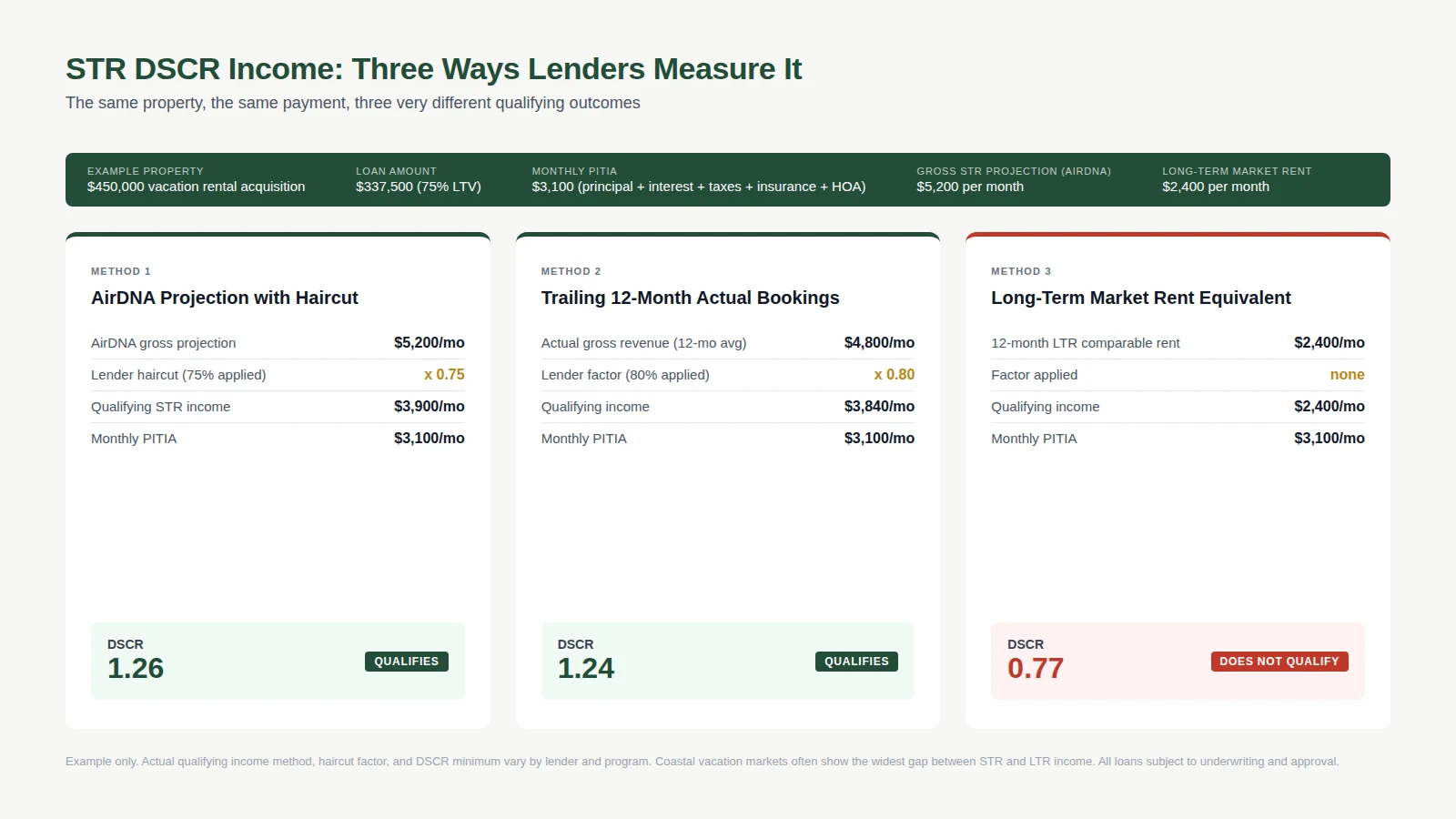
The income method is not a footnote in the term sheet. Ask for it directly before you spend money on an appraisal, because two lenders can look at the same file and one qualifies it at 1.26 while the other declines it at 0.77.
Want terms on a specific deal?Answer seven questions and get a decision in 72 hours.
Get FundingWhat determines which method a lender uses
Most lenders who actively fund STR DSCR loans fall into predictable categories, and a few variables shape which method applies to your file:
| Factor | Effect on income method |
|---|---|
| 12+ months of actual booking history | Most lenders shift to actual platform statements; on a strong performer, this beats projections |
| New acquisition, no operating history | Lender must use AirDNA projection or market rent; the lender’s program determines which |
| Jurisdiction with active STR regulation risk | Conservative lenders apply market rent cap regardless of AirDNA data |
| Condo or HOA-governed property | Some programs exclude properties in buildings whose HOA docs restrict STR use |
| LTV at or above 75 percent | Higher LTV requests often restrict qualifying income to actual 12-month history only |
| Portfolio vs. securitized lender | Lenders who securitize loans tend toward conservative income methods; portfolio lenders carry more flexibility |
The rate premium for short-term rental financing
STR DSCR loans carry a rate premium over standard long-term rental DSCR loans. The spread is typically 0.25 to 0.75 percentage points, driven by two factors: income volatility (seasonal bookings are harder to model forward than a signed lease) and regulatory risk (an STR restriction ordinance can eliminate the income stream that qualified the loan).
On a $337,500 loan, a 0.50 percentage point premium is approximately $105 per month, or $1,260 over 12 months. It does not change whether you qualify, but it does change the cash-on-cash return in year one. Factor it into your pro forma before you close, not after you are wondering why the cash flow is thinner than projected.
Our DSCR loan rate tiers post covers how DSCR band and LTV affect base pricing. For a short-term rental, that base rate is the starting point, and the STR premium stacks on top of whatever tier your file lands in.
STR regulations: the risk that changes the underwriting
Dozens of municipalities have restricted or banned short-term rentals since 2022. The trend is not uniform, and many vacation markets remain permissive. But the regulatory direction in densely populated cities and some resort towns is toward more restrictions, not fewer. Underwriters are aware of this, and it shows up in two ways: stricter income methods in known-risk markets, and lower LTV caps even where projections are otherwise accepted.
The practical risk is specific. If a property qualifies on STR income and the STR permit is restricted or not renewed after close, the property converts to long-term rental use. In vacation coastal markets, the LTR equivalent rent is often materially below the STR income. The loan does not get recalled, but the property may no longer support a DSCR refinance on LTR income, limiting your exit options and changing your cash flow.
Before you close, run the LTR scenario through the DSCR calculator using the market rent comparable, not the STR projection. If the LTR DSCR comes in below 0.85, the regulatory scenario is real exposure. That does not make the deal wrong, but it changes how you size the down payment and the cash reserves you carry into close.

Who this loan is right for, and who it is not
A DSCR loan on a short-term rental works best when the property has real operating history, the STR market is established, the jurisdiction is stable or permissive, and the LTV request gives the lender room on the income method. A property that earned $60,000 last year in a stable mountain or coastal vacation market, financing at 70 percent LTV, is a straightforward file in most of these programs.
This loan is wrong for you if:
- You are buying a vacation property you plan to occupy personally, even part of the year. Business-purpose loans require the property to be operated as an investment rental. Personal use on a business-purpose loan is misrepresentation on the application.
- The deal only passes on peak-season STR revenue. A property at 1.05 DSCR using the AirDNA projection for July and August, but earning materially less in October through April, has no margin. The payment does not adjust with the calendar.
- The property is in a jurisdiction that has recently restricted STR permits, is actively debating restrictions, or where the regulatory climate is hostile to investor-owned short-term rentals. Some lenders decline the market outright; others price for the risk at LTVs you may not want to accept.
- The long-term market rent does not support a 1.0 DSCR and the deal only passes on AirDNA projections. You have essentially zero margin for a soft season, a new competitor in the market, or a platform fee change. All three of those scenarios are common over a three to five year hold.
For the right property and market, see our DSCR rental loan program page for program details, or call 917-842-9982 to discuss a specific file.
The documents a short-term rental file needs
Beyond the standard DSCR package (appraisal, title report, credit pull, entity documentation), an STR file needs additional material that many borrowers do not have ready at application:
- 12 months of Airbnb, Vrbo, or property management platform statements if you have them. Platform net payouts are what lenders want, not gross booking amounts before fees.
- An AirDNA report for the specific property address, if the lender accepts projection-based income. Some lenders pull this themselves; others require you to provide it at application.
- Evidence that the property holds an active STR permit, or documentation that the jurisdiction does not require one. This has delayed more files in the past 18 months than almost anything else in the STR product category.
- HOA documents or condo rules confirming STR use is allowed, if the property is in a governed community.
Missing any of these at application adds a week or more to timeline. Our post on what lenders check before issuing a term sheet covers how to front-load the full document pack so you are not chasing paper after the term sheet is in hand.
A note on numbers and approvals: The figures in this post are worked examples based on market ranges observed in late 2026. Your actual rate, LTV, minimum DSCR, and income calculation method will depend on the property, your credit profile, and the specific lender’s program guidelines. All loans are subject to underwriting and lender approval. STR regulations vary by municipality and change frequently. Confirm current permit status and local ordinance before relying on STR income to qualify a file.
Common questions
Can you use AirDNA projections to qualify for a DSCR loan when the property has no rental history?
Some lenders accept AirDNA projections for acquisition files where no operating history exists. The projected gross is typically discounted to 70 to 80 percent to account for vacancy, seasonality, and platform fees. Not every lender accepts projections: some require 12 months of actual statements, which means you would need to season the property as a short-term rental before a DSCR refinance works. Ask the lender directly which income method they use before ordering an appraisal.
What DSCR do you need on a short-term rental?
Most programs require a minimum of 1.0, but pricing improves meaningfully at 1.20 to 1.25. Because STR income has more variability than a signed lease, a DSCR of 1.0 on projected income is a borderline file at most lenders. It may qualify, but it will price at the highest rate tier and may require additional reserves. Targeting 1.20 or above on the conservative income method gives you a more defensible file and better pricing.
Does a short-term rental DSCR loan cost more than a standard DSCR rental loan?
Yes, in most cases. The STR premium over a comparable long-term rental DSCR loan at the same LTV and credit profile is typically 0.25 to 0.75 percentage points. The gap narrows if you have strong actual booking history and a low LTV. It is wider on acquisition files in jurisdictions with known regulatory risk, or at LTVs above 70 percent.
What happens to the loan if my market restricts STR permits after I close?
The loan is not called due to a regulatory change after closing. However, if you have to convert to long-term rental use, the LTR equivalent income may produce a DSCR below 1.0 in vacation markets, which limits your ability to refinance into another DSCR loan in the future and changes your cash flow materially. Before closing, run the LTR scenario through the DSCR calculator. If the LTR DSCR is below 0.85, price that risk into your down payment and reserve planning rather than treating it as a remote scenario.
Can you buy an Airbnb you also plan to use yourself with a DSCR loan?
No. DSCR loans are business-purpose, investment-purpose loans. They are not available for any property where you intend personal occupancy, including part-time personal use. If you want to buy a vacation property that you also rent out periodically, you need a second home loan or a conventional investment property loan, not a DSCR product. Using a business-purpose loan for a property with personal occupancy constitutes misrepresentation on the loan application.
Ready to fund your next deal?
Approval within 72 hours. Close in 5 to 10 business days.
Get Funding Now