Why a Deal Gets Declined After a Verbal Approval
A verbal approval means a lender said the deal looks qualified. It is not a commitment to fund. Between that call and your closing, an appraiser, title search, budget review, and credit pull each have the ability to kill the deal. Here is what triggers the decline and how to reduce the risk.

A verbal approval means a lender looked at your numbers and said the deal qualifies. It is not a commitment to lend. Between that call and your closing, an appraiser, a title search, a budget review, and a credit pull each have the ability to kill the deal. The four triggers are predictable, and most of them are fixable before they become declines, but only if you know what to look for.
This post is for real estate investors on business-purpose loans. If you are buying or refinancing the home you live in, business-purpose lenders cannot fund that transaction. Consumer mortgage lending is a separate category governed by different rules, different timelines, and different disclosure requirements.
What a verbal approval actually means
Business-purpose lending has three meaningful levels of lender commitment, and conflating them is the most common source of deal disappointment:
- Verbal approval: The lender reviewed your description of the deal and said it looks like it qualifies based on what you told them. No documents have been verified. This is a screening conversation, not a commitment to fund.
- Indicative term sheet: A written indication of loan amount, rate range, points, and LTV. Still subject to underwriting and stated conditions. Getting this in writing is a meaningful step, but it is not a commitment letter.
- Commitment letter: Underwriting is complete. The lender has reviewed all documents, the appraisal, the title search, and the borrower file. Conditions are listed. Subject to satisfying those conditions, the lender is bound to fund.
The verbal approval lives at the start of a process that takes five to fifteen business days to reach a commitment letter. Plenty can surface in that window. For a full breakdown of what goes into the review before a term sheet is issued, see what lenders check before they issue a term sheet.
The four things that kill a deal after a verbal yes
The appraisal comes in below your number
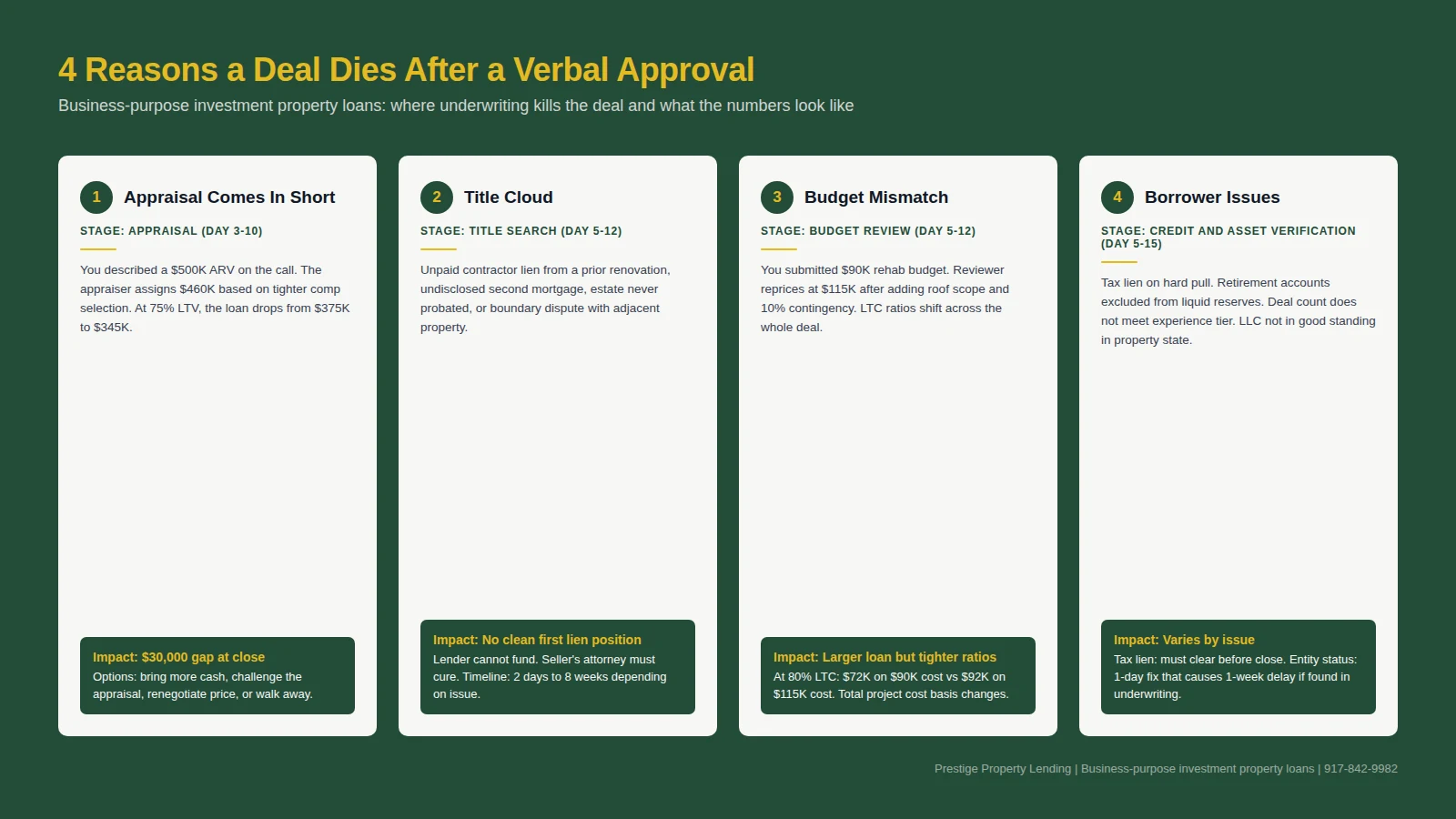
On a bridge or hard money loan, the lender is lending against current value or after-repair value. You described the property on the call as supporting a $500,000 ARV. The appraiser assigns $460,000 based on a tighter comp selection. At 75% LTV, the lender was discussing a $375,000 loan. At the actual $460,000 appraised value, that same 75% LTV produces a $345,000 loan. You are $30,000 short at the closing table.
That gap does not mean the deal is dead. It means your options are: bring more cash to close, challenge the appraisal with better comparables, renegotiate the purchase price, or walk away. But it does mean the loan amount you discussed verbally is not the loan you are getting.
Stress-test your number before you call a lender. Use the ARV calculator to find your break-even appraised value. If an appraiser came in 8% below your projection, what does that do to the deal’s margin? If the answer is that it kills the deal, you are priced without a buffer. For a detailed look at how appraisers actually build a value, see how appraisers set ARV and why yours is lower.
Title issues the seller did not disclose
A title search runs through public records and surfaces what the seller may not know, or may have chosen not to mention: an unpaid contractor lien from a renovation two owners ago, a boundary dispute with the adjacent property, a second mortgage that was not satisfied at the last sale, an estate that was never probated and where not all heirs are signatories on the current contract.
The lender needs a clean first lien position. A cloud on title blocks that position, and the loan cannot close until the cloud is resolved. Some issues resolve in days: a lien from a prior contractor gets paid out of closing proceeds. Others take weeks or months: an unclosed estate, a contested boundary line, a lender dispute over priority between two recorded instruments.
The practical move is to order a preliminary title search before you submit the loan application. Many title companies run a preliminary for $100 to $200 and return results in two to three days. If a cloud exists, you find it on your own timeline, not the lender’s, and you can address it before you have appraisal costs, commitment fees, and weeks of carrying costs invested in the deal.
The rehab budget does not survive review
On a fix and flip or construction loan, your contractor’s budget gets reviewed by an internal cost estimator or an independent third party. That review often produces a different number than what was submitted, because scope items get repriced against current material and labor costs, and standard contingency lines get added when the original estimate omitted them.
Here is a worked example. You submit a $90,000 rehab budget. The lender’s reviewer reprices the scope at $115,000 after adjusting the kitchen allowance, adding a roof line your contractor flagged as optional, and applying a 10% contingency. At 80% LTC, the construction loan component changes from $72,000 to $92,000. That is a larger loan, but the total project cost also increased, which changes every ratio in the underwrite. If the revised LTC or combined LTV breaches the lender’s program limits, the loan gets cut and you come to closing short on capital.
Submitting a line-by-line budget rather than a single number speeds up review. When every scope item is listed separately with quantities, unit costs, and a contingency line, the reviewer prices from your list instead of building one from scratch. Discrepancies surface earlier, when there is still time to address them before the loan is structured.
Borrower issues that surface during verification
The verbal conversation ran on what you described about your finances and track record. Full underwriting verifies it. Common surprises at this stage:
- Tax liens: A federal or state tax lien that did not appear on a soft credit pull. Lenders will not fund until the lien is cleared or formally subordinated. IRS resolution can take six to eight weeks if the lien is contested.
- Liquid reserves counted wrong: You reported $150,000 in assets. Bank statements show $80,000 in checking and savings and $70,000 in a rollover IRA. Many business-purpose lenders discount or exclude retirement accounts because they are not readily accessible. Your verifiable liquid number is $80,000, not $150,000.
- Experience tier mismatch: You described six completed flips on the call. The lender verifies by HUD settlement statements. If two of those flips fell below the lender’s minimum project size for counting toward their experience tier, you might qualify at a less favorable LTV or rate than was discussed on the phone.
- Entity not in good standing: Your LLC did not file its annual report in the state where the property is located. The lender will not take the entity as borrower until it is reinstated. This is a one-day administrative fix that becomes a week-long delay when you discover it during underwriting instead of before you applied.
Want terms on a specific deal?Answer seven questions and get a decision in 72 hours.
Get FundingThe timeline from verbal to commitment
| Stage | Typical timing | Common decline trigger |
|---|---|---|
| Verbal approval | Day 1 | None; this is a screening conversation only |
| Indicative term sheet issued | Day 2 to 4 | Not a commitment; easy to treat as one |
| Appraisal ordered and received | Day 3 to 10 | Value below description; ARV methodology gap |
| Title search complete | Day 5 to 12 | Unpaid liens, undisclosed mortgage, estate issue, boundary dispute |
| Budget review (construction or flip) | Day 5 to 12 | Scope repriced higher; contingency added; LTC ratios shift |
| Credit and asset verification | Day 5 to 15 | Tax lien, thin liquid reserves, experience mismatch, entity status |
| Commitment letter issued | Day 8 to 20 | Conditions listed; closing requires satisfying each one |
How to reduce the gap between verbal and commitment
Four steps that meaningfully reduce decline risk before you submit a loan application:
Order a preliminary title search first. A title company’s preliminary search costs $100 to $200 and takes two to three days. If a cloud exists, you find it on your timeline, not the lender’s. You can use it to negotiate a price reduction, demand a cure from the seller, or simply walk away before you have appraisal fees and commitment deposits at risk.
Know your actual liquid number before you call. Pull the last 60 days of bank statements. Add checking, savings, and accessible brokerage accounts. Do not count retirement accounts until you verify the lender’s specific policy on them. The number you quote on the phone should be the number a bank statement will confirm, not your total net worth on a balance sheet.
Submit a line-by-line contractor budget. Line items, quantities, unit costs, labor and materials listed separately where the estimate allows, and a 10% contingency line. A detailed budget clears review faster and reduces the risk of a surprise reprice that changes your loan structure late in the process.
Verify your entity’s standing before you apply. Pull a certificate of good standing from the state where your LLC is registered and from the state where the property is located. This is a five-minute online check that prevents a week-long delay in underwriting when the lender flags the entity at the document review stage.
When you can push back after a decline
Not every post-verbal decline is a dead end. Two situations where you have real options:
On the appraisal: Request a reconsideration of value through your lender. You submit three to five comparable sales that the appraiser did not use, with a brief explanation of why each is more relevant than the comps the appraiser selected. The appraiser reviews the submission and either stands firm or revises the report. It works in a meaningful portion of cases, particularly when the investor can identify a recent sale the appraiser excluded because of proximity, timing, or condition adjustments. Request one any time the gap between your number and the appraiser’s is $15,000 or more.
On title issues: A title cloud is almost always the seller’s problem to cure. If a contractor lien surfaced that the seller did not disclose, the seller’s attorney handles the payoff at closing or before. Your job is to make sure your contract’s due diligence period gives you room to wait. If the contract clock runs out while the title issue is being resolved, you risk losing the property through no fault of the lender.
You can also bring the same deal to a second lender after a decline. A decline from one business-purpose lender does not affect your credit score the way a consumer mortgage denial does. Different lenders have different program parameters, appraisal methodology preferences, and experience tier standards. A deal that falls outside one lender’s limits may close with another. See our bridge loan program and hard money loan program for program terms on investment property deals from $100,000 to $25,000,000.
Who this loan is wrong for, and what slippage costs
If you are purchasing or refinancing the home you live in, these loans are not for you. Business-purpose lenders do not fund owner-occupied primary residences. The underwriting framework, the pricing, and the closing speed all assume an investor transaction on a property held for business purposes.
If your deal’s margin depends on getting the exact loan amount discussed on the phone, and an 8% appraisal variance would make the deal unprofitable, do not go under contract yet. Price in appraisal friction at the offer stage. A $500,000 ARV deal where the margin disappears at $460,000 is a deal with no buffer. That buffer should come from the purchase price, not from an assumption of appraisal certainty.
If your liquid reserves are below what the lender requires and you are planning to talk your way through the verification, a verbal approval based on your description will not survive asset verification. Know your actual verified liquid number before you apply.
The real cost of friction: appraisal fees are non-refundable once the appraiser has completed the assignment. On a $400,000 deal, that is $600 to $1,200 gone whether the loan closes or not. Carrying costs run during the underwriting period regardless of outcome. A $400,000 bridge at 10% annualized is roughly $3,300 per month in interest. A three-week appraisal dispute costs about $2,500. A title cloud that takes six weeks to resolve is $5,000 in carry plus whatever you paid for the preliminary title work you should have done before submitting. Budget for friction in time and money before you sign the purchase contract.
Call 917-842-9982 to discuss a specific deal before you go under contract. It takes less time to find the problems when the deal is still hypothetical than to fix them after an appraisal has been ordered and a title search is already running.
Common questions
Can a lender issue a commitment letter before the appraisal is complete?
No. A commitment letter requires a completed appraisal because the lender’s maximum loan amount is calculated against the appraised value. Some lenders issue a conditional commitment that lists the appraisal as an open condition, but the loan amount in that letter will be revised once the appraisal report comes back. Do not plan your closing around the conditional number.
How long does underwriting take after a verbal approval on a business-purpose loan?
On a business-purpose investment property loan, expect five to fifteen business days from verbal approval to commitment letter when the file is clean. The variables are appraisal turnaround in the property’s county, title search speed, and how quickly you submit a complete document package. A first-time borrower or a deal with a construction component typically takes longer than a repeat borrower on a straightforward bridge loan. Five to ten business days is realistic for a fully documented, clean file.
What is a reconsideration of value and how do I request one?
A reconsideration of value is a formal request for the appraiser to review additional comparable sales you provide. You submit three to five comps with a brief written explanation of why each is more comparable than what the appraiser used. The appraiser reviews the submission and either stands firm or revises the report. Ask your lender to initiate the process; borrowers typically cannot contact the appraiser directly. Request one any time the gap between your number and the appraiser’s is $15,000 or more.
If my deal gets declined mid-underwriting, do I lose my appraisal fee?
Appraisal fees are typically non-refundable because the appraiser completed the work before the decline. On a $400,000 deal, expect to lose $600 to $1,200. Points and origination fees are generally not charged until closing on business-purpose loans, so a pre-close decline usually means you lose only the appraisal cost. Confirm the lender’s policy before you apply, because some lenders charge an application fee or commitment fee that is earned at commitment rather than at closing.
Can I take the same deal to a different lender after a decline?
Yes. A decline from a business-purpose lender does not appear on a credit bureau the way a consumer mortgage denial does, and it does not affect your credit score. You can take the same deal to a second lender. Disclose what happened and why. Different lenders have different program parameters, and a deal that falls outside one lender’s limits may qualify with another. Bring your complete document package so the second lender can move faster through underwriting.
Ready to fund your next deal?
Approval within 72 hours. Close in 5 to 10 business days.
Get Funding Now