Construction Loan vs Bridge Loan: How Real Estate Investors Choose Between Them
Construction loans fund ground-up builds draw by draw. Bridge loans move on existing assets in transitional states. The investor version of how to tell them apart, with a real cost comparison and a five-scenario decision table.
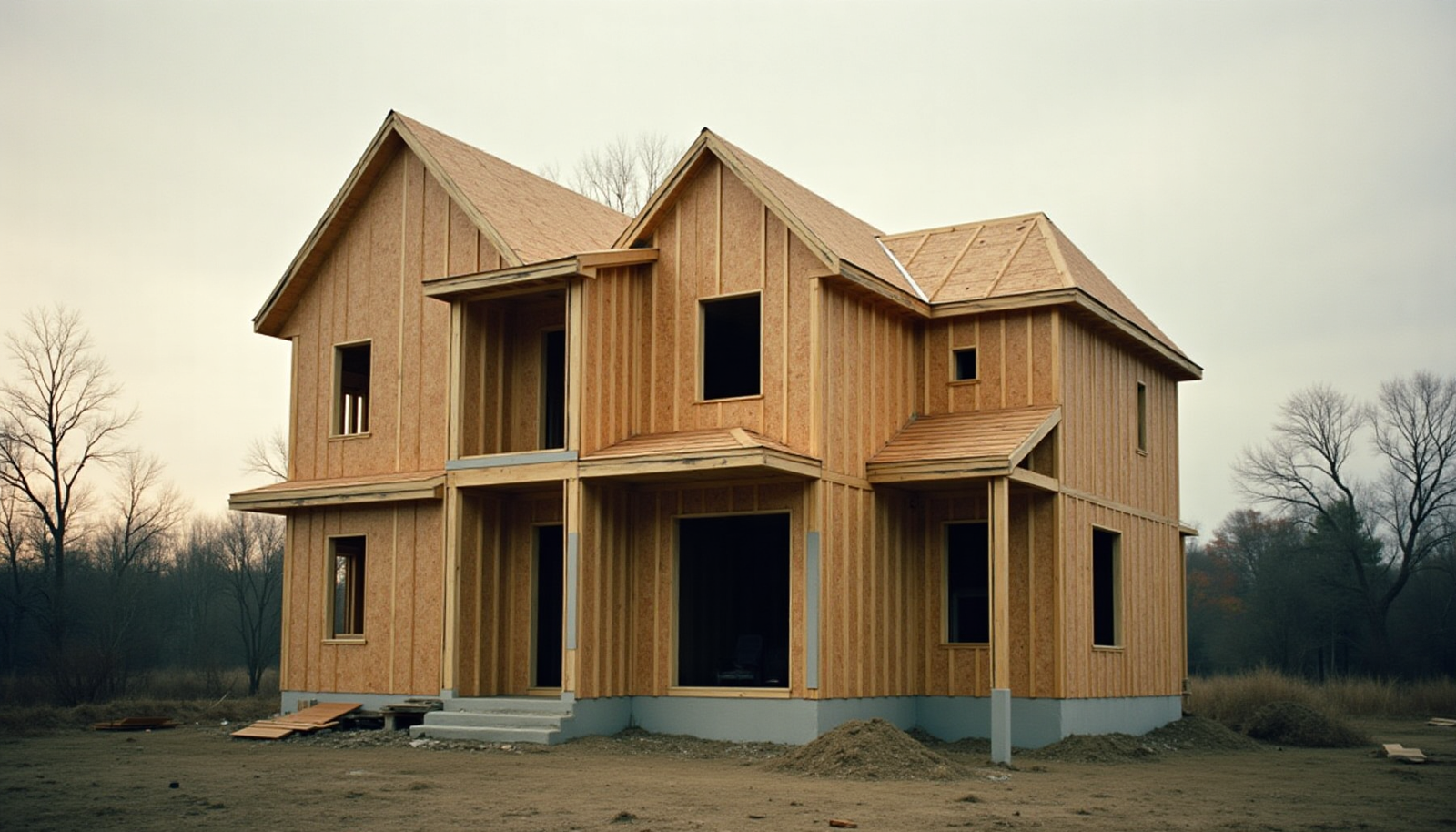
A construction loan and a bridge loan both run 12 to 24 months, both price like short-term debt, and both show up in conversations about investor financing. The difference is what the loan is funding. If dirt is turning into a building, you need a construction loan. If a building already exists and you are crossing a financing gap, a bridge loan is the tool. This post is for investors only. Owner-occupants building a primary residence or homeowners bridging between two houses are working with different products under different rules: consumer construction-to-perm loans and residential bridge products that PPL does not fund.
How a construction loan is structured
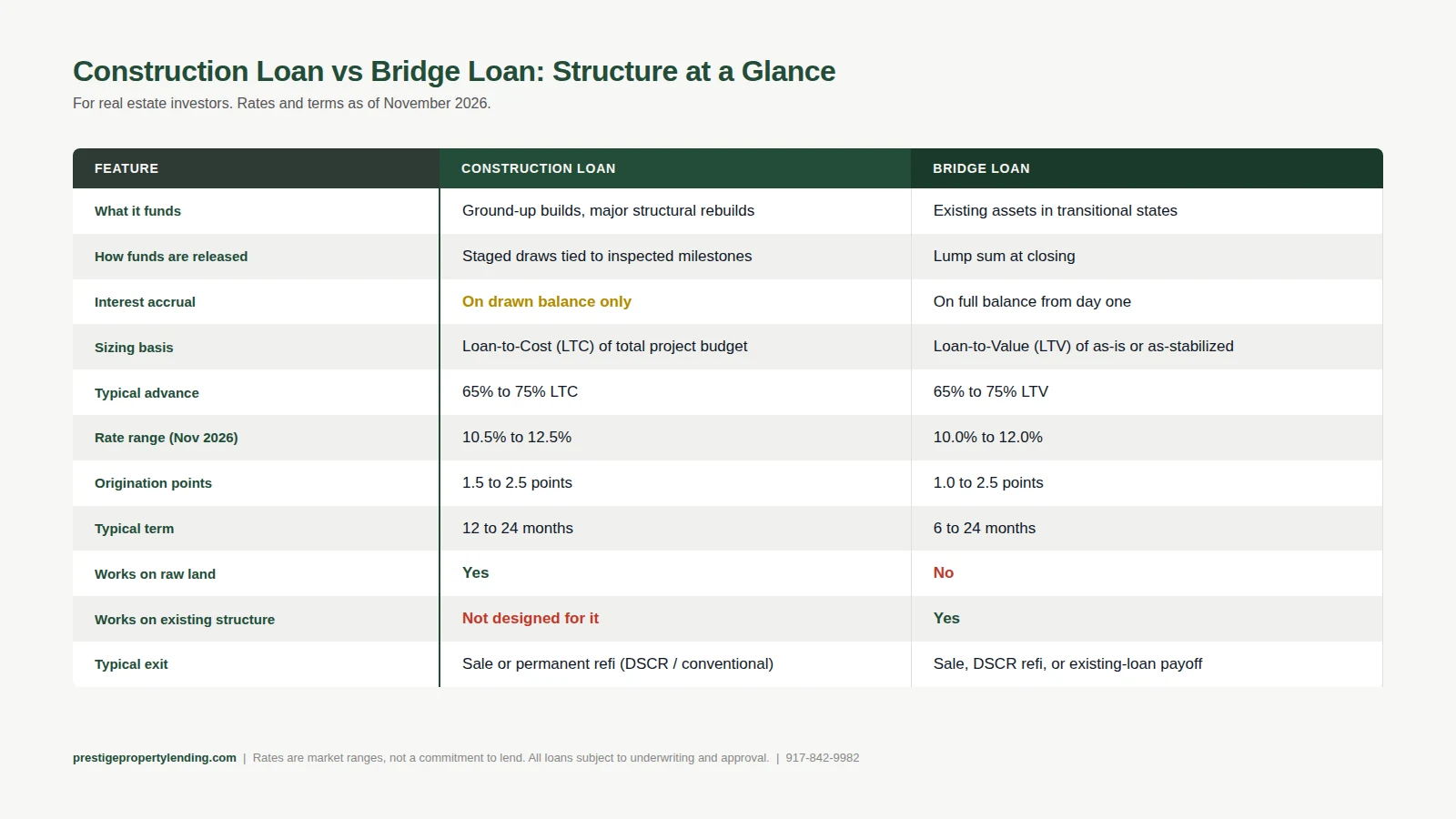
A new construction loan funds a build in stages called draws. The lender does not advance the full commitment on day one. You draw against the loan as each phase clears inspection: land clearing, foundation, framing, rough mechanicals, drywall, finishes. Interest accrues only on the amount drawn, not the full loan balance.
That draw mechanic has a real dollar impact. On a $600,000 construction loan at 11.5%, a full balance from day one costs $5,750 per month. If you only draw $120,000 in month one to cover land and foundation work, your interest payment that month is $1,150. Total carry drops materially because you are not paying interest on money you have not yet spent.
The loan is sized on loan-to-cost (LTC), not loan-to-value. If your total project cost is $820,000 (land purchase, hard costs, soft costs, interest reserve), and the lender advances 70% LTC, your construction loan is $574,000. You contribute the remaining $246,000 as equity before or alongside the first draw. The completed building’s appraised value matters for your exit, whether that is a sale or a refinance into a DSCR rental loan, but it does not determine how much you can borrow during the build.
Approval requires more documentation than any other investor loan. The lender wants approved plans and permits, a detailed hard cost budget broken down by trade, proof your general contractor is licensed and has completed comparable work, and an appraisal valuing the property subject to completion. Missing any of those stalls the file. See our post on construction loan requirements for a full breakdown of what gets a file declined.
How a bridge loan is structured
A bridge loan is a lump-sum, asset-backed short-term loan. The full balance is advanced at closing. You are not drawing against inspected milestones: you receive the money and begin paying interest on the entire amount from day one.
Bridge loans work for investors in three scenarios. First, you are buying a property that cannot qualify for DSCR financing yet because it is vacant, occupied below market rent, or needs light work before it stabilizes. Second, you have capital locked in a property you have not sold yet and need to close on the next acquisition. Third, you are buying a value-add multifamily at an occupancy level that does not support a DSCR calculation until you lease it up.
Underwriting is asset-first. The lender looks at the property’s current value or its as-stabilized value, your exit strategy, and your ability to carry the loan. Income verification is minimal compared to a conventional loan. FICO matters but is not the primary underwriting factor. At 70% LTV on a $900,000 acquisition, your bridge loan is $630,000. No draws, no inspections, no staged funding.
Want terms on a specific deal?Answer seven questions and get a decision in 72 hours.
Get FundingThe cost comparison on a real deal
To make the distinction concrete, here are two scenarios on a $600,000 ground-up build with a completed value of $950,000. The loan cost calculator can help you model your own numbers.
Construction loan scenario
Loan amount: $560,000 at 70% LTC on an $800,000 total project budget. Rate: 11.5% interest-only on the drawn balance. Points: 2.0 at origination ($11,200). The build runs 15 months across six draws. Draws accelerate mid-project: the first two draws total $170,000 (land clearing and foundation), draws three through five total $310,000 (framing through drywall), draw six at $80,000 covers finishes and site work. Interest accrues on each tranche from the day it is drawn. Total interest over the 15-month build: approximately $41,000, calculated on a draw-weighted basis. Add origination points: all-in financing cost is roughly $52,200. The property sells at $950,000, leaving you with proceeds to analyze against total costs.
Why a bridge loan cannot substitute here
A bridge loan requires an existing structure to lend against. Raw land does not have an as-is value that supports a loan-to-value calculation at the size a construction project needs. If you tried to bridge a ground-up build, you would find no investor lender willing to advance 70% of a lot’s value and call it a construction commitment. The two products do not compete on this deal: they are not interchangeable.
Where the comparison becomes real: an investor buying a standing property that needs significant renovation might debate whether a bridge loan or a fix-and-flip loan (a draw-based product, structurally closer to a construction loan) better fits the deal. Light cosmetic work that does not change the building footprint or require permits typically uses a bridge. A gut rehab that extends a basement, adds a unit, or requires structural permits may need a construction product because bridge lenders do not want to advance against a building mid-demolition.
Five investor scenarios and which loan fits
| Scenario | Construction Loan | Bridge Loan |
|---|---|---|
| Ground-up build on raw land | Yes | No |
| Gut rehab with structural changes or additions | Possibly, depending on scope | Unlikely |
| Cosmetic renovation before DSCR refi | No | Yes |
| Vacant building, buying time to lease up | No | Yes |
| Need to close on acquisition before existing asset sells | No | Yes |
Where they overlap: the construction bridge
One product sits at the intersection: a construction bridge loan. This is a bridge taken on a nearly complete or recently complete build while the borrower waits for a certificate of occupancy or long-term financing to clear. The building exists and can be valued. The DSCR underwriting clock has not started because there are no tenants yet. A construction bridge is not a standard bridge and not a construction loan. It is a short-term exit from a construction loan that a builder takes when the CO is 30 to 90 days out but the permanent financing timeline is longer than the remaining construction loan term allows.
If you are in that position, the conversation with your lender starts with the draw schedule payoff balance and the appraisal subject to completion. Lenders will typically advance 65% to 70% of the as-complete value on a construction bridge, subject to the building being substantially complete.
When each loan is the wrong choice
Construction loans are wrong for you if you cannot fund 25 to 35 percent of total project cost in equity. Lenders will not stretch LTC above 70% to 75% on most markets, and trying to find one that will is a sign the deal does not pencil. Construction loans are also wrong if your general contractor does not have a completed-project track record the lender will accept, if your timeline requires occupancy in under 12 months (most ground-up builds run longer than the borrower’s original schedule), or if the subject-to-completion appraisal comes in below your budgeted total cost.
Bridge loans are wrong for you if there is no existing structure to appraise. Raw land or a foundation with no framing does not support a bridge. They are also wrong if the exit requires appreciation that has not happened yet rather than a refi against existing cash flow, if the loan term ends before your stabilization plan completes, or if you are carrying multiple bridge loans simultaneously where one slip in one property creates a cascade across the others. For more on bridge loan costs and how extensions are priced when the hold extends, see our post on bridge loan rates and all-in costs.
Both products price at rates that look alarming when annualized. A 12% bridge loan on a 9-month hold is not 12% of your loan amount. The actual interest cost is 9 months at 1% per month: 9% of the balance plus origination points. The metric that matters is total financing cost on the specific hold period, not the stated annual rate. For a worked example of how to model a construction project’s full carry costs across a draw schedule, see our construction loan draw schedule guide.
When both fail: Neither a construction loan nor a bridge loan will fund a deal where the property’s exit depends on market appreciation alone and there is no cash flow or sale proceeds in the underwritten exit. Lenders require a clear, underwritten exit at the loan’s term. If yours is “the market will be higher,” that is not a lender-acceptable exit strategy for either product.
What to do next
If you are building from the ground up, start by modeling your draw schedule and equity contribution against total project costs. The ARV calculator can help you stress-test the completed value against different market conditions before you commit to a budget. If you are bridging an acquisition, run your DSCR exit at a rate 50 to 75 basis points higher than current market to make sure the deal still works if rates move before you refi. Call 917-842-9982 to discuss which product fits your deal.
Common questions
Can you use a bridge loan to fund construction?
No. A bridge loan requires an existing structure with a lendable as-is or as-stabilized value. Raw land or an empty foundation does not support a bridge lender’s loan-to-value calculation. If you need to fund a ground-up build, you need a construction loan sized on loan-to-cost. The two products are not interchangeable on a new build.
Which loan has lower interest cost: construction or bridge?
Construction loans often carry slightly higher rates than bridge loans (10.5% to 12.5% vs. 10.0% to 12.0% as of late 2026), but total interest cost on a construction loan is typically lower because interest accrues only on the drawn balance. A 15-month bridge on a full balance costs more in total interest than a 15-month construction loan where you are drawing incrementally. The comparison depends on your specific draw schedule and hold period.
What happens when a construction loan term ends before the build is complete?
You need an extension or a refinance. Most construction lenders offer a formal extension for one to three additional months at a cost of one to two points on the outstanding balance plus a possible rate increase. If the build is substantially complete, a construction bridge loan may be an option. Extensions are not automatic: the lender will want to review remaining budget and updated project status before approving. Budget for at least one extension when you underwrite the deal.
Do construction loans and bridge loans both require a personal guarantee?
Most business-purpose investor loans, including both construction and bridge products, require a personal guarantee. The guarantee does not go away because the loan is titled in an LLC. What typically varies is the recourse structure: full recourse means the lender can pursue all of your personal assets in a default; some loans carve out limited recourse with specific bad-boy carveouts. Expect full recourse on both products unless the loan amount is large enough and the borrower’s track record strong enough to negotiate otherwise.
Can you switch from a construction loan to a bridge loan mid-project?
Not mid-draw. Once a construction loan is active and draws are being disbursed against an in-progress build, switching to a bridge loan requires paying off the construction loan and refinancing. That is only feasible once the building is far enough along that a bridge lender can value the existing structure. Some builders do this near the end of a project if they want to free up the construction lender’s holds and move to a simpler interest-only bridge while they lease up. It adds transaction costs and is not worth doing unless there is a specific reason the construction loan terms are creating a problem.
Ready to fund your next deal?
Approval within 72 hours. Close in 5 to 10 business days.
Get Funding Now