Credit Score Requirements for Real Estate Investor Loans: What Changes at Each Product Type
Business-purpose investor loans have different credit score minimums than conventional mortgages. DSCR starts at 620, hard money at 580. Here is what the minimum actually is by product type, what a below-680 score costs in rate, and the credit events that kill any application regardless of product.

If you are financing an investment property through a conventional Fannie Mae or Freddie Mac loan, lenders typically want 700 to 720 for best pricing and require at least 620 to approve at all. This post is not about those loans. It is for investors who use business-purpose financing: DSCR rentals, hard money, fix and flip, bridge, and construction. The credit score rules are different, and in some cases your credit score has almost nothing to do with whether you get the loan.
This post is not for someone buying a home they will live in. Business-purpose investor loans are exempt from TILA and RESPA because they are not consumer loans. If you are looking for FHA, VA, or conventional investment property guidelines, every bank website covers that. What they do not cover is what actually happens to your rate and your LTV when you bring a 630 or a 660 to a DSCR table.
Why investor loans and conventional mortgages treat credit differently
A conventional mortgage lender is underwriting the borrower: your income, your DTI, your payment history. A business-purpose lender is underwriting the deal: the asset value, the rent or resale exit, and your ability to execute. Credit score matters, but it sits behind the asset in the priority order.
This shows up concretely. A hard money lender funding an experienced flipper at 65% LTV on a solid ARV may approve a 600 score they would not touch in a primary residence context. A DSCR lender will sometimes approve a 640 on a 1.25 DSCR property where a 740 borrower with a 1.0 DSCR faces friction on LTV. The asset is the collateral, and the collateral backstops the risk in a way that changes how much credit history matters.
That said, credit still affects three things on every investor product: whether you get approved at all, what rate tier you land in, and how much LTV the lender will extend. All three are worth understanding before you go to term sheet.
Credit score minimums by product type
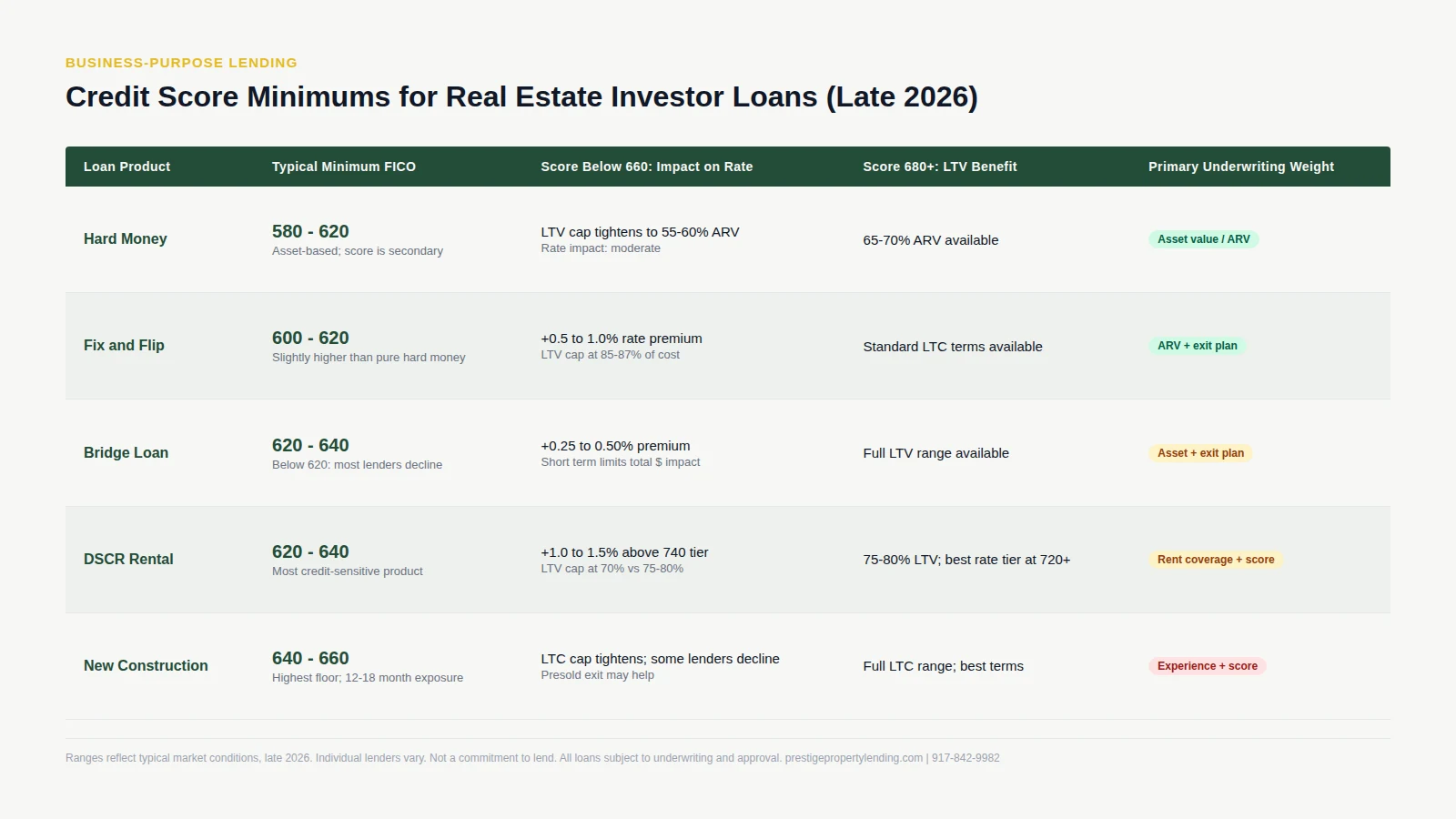
The numbers below reflect what most business-purpose lenders operate in the current market. Individual lenders vary, and a larger portfolio or more liquidity can sometimes offset a lower score. These are thresholds where deals actually close, not marketing language from a rate sheet.
Hard money loans
Hard money is the most asset-driven product on this list. Minimum scores typically run from 580 to 620. Lenders in this space care far more about your LTV relative to ARV, the quality of your contractor, and your exit plan than they do about whether you paid a card late four years ago. A 600 score with strong deal fundamentals will close where a 720 borrower with a poor ARV comparison or no exit plan will not.
What credit does affect on hard money: at scores below 620, some lenders cap LTV more aggressively, pushing you to 55 or 60 percent of ARV rather than 65 to 70. At 580 to 599, your choices narrow to lenders who explicitly serve credit-impaired borrowers, and they price accordingly. See the hard money loan program page for how the asset side of this product gets underwritten. For the full picture of what hard money lenders look at beyond credit, the hard money loan requirements post walks through how experience and liquidity rank relative to the borrower credit profile.
Fix and flip loans
Fix and flip overlaps substantially with hard money but tends to run slightly higher minimums, typically 600 to 620. The reason is that fix and flip borrowers draw funds progressively during the rehab, which creates ongoing exposure across the construction phase. Lenders view that as more complex risk management than a one-time bridge, and they want slightly more borrower stability to accompany it.
At 620 to 659, pricing on a fix and flip usually carries a half to one point premium over what a 680 or above borrower pays. At 660 to 679 you are close to the standard tier. At 680 and above you are at or near best pricing for the experience tier you qualify for. Use the fix and flip calculator to run the all-in cost at different rate scenarios before deciding whether a 90-day credit improvement is worth the wait.
DSCR loans
DSCR is the most credit-sensitive product in the business-purpose investor space, because DSCR loans are held as long-term rentals and go into securitized pools. Most DSCR lenders set a floor of 620, with pricing that steps up meaningfully from 620 to 680 and again from 680 to 740.
A 620 score on a DSCR loan will typically carry a 1.0 to 1.5 percent rate premium over what a 740 borrower pays on the same deal. A 660 carries roughly 0.5 to 0.75 percent above the 740 tier. For a $350,000 loan over a 30-year term on an interest-only product, a 1.25 percent rate difference is about $365 per month. That is worth calculating before you decide to close now vs. wait a few months to push your score past 680.
DSCR also has a secondary credit effect: LTV caps tighten at lower scores. A 620 score might cap at 70 percent LTV where a 720 qualifies for 75 to 80. On a $500,000 property, that extra 5 percent LTV represents $25,000 of additional equity you need at close. For more on how DSCR underwriting works as a whole, the DSCR rental loan program page covers the full qualification structure. The DSCR calculator lets you model your specific deal at different rate inputs.
Bridge loans
Bridge loans typically require 620 to 640 as a floor, with less rate sensitivity to credit than DSCR because bridge is a short-term product. When you are holding a loan for 6 to 12 months, the rate premium from a 650 score over a 720 score matters less in absolute dollar terms than it does on a 30-year DSCR. Lenders know this and price bridge credit sensitivity accordingly.
At 580 to 619, most conventional bridge lenders will not close the file. This is not about their appetite for the asset; it is about secondary market execution and internal policy floors. Hard money bridge is an option at this range, but hard money bridge pricing (12 to 14 percent plus points as of late 2026) makes the math harder to close unless the deal has strong fundamentals.
New construction loans
Ground up construction has the highest minimums of any product here, typically 640 to 660. The reason is that construction loans span 12 to 18 months, with repeated draw and inspection cycles, and the lender has exposure throughout. A borrower who hits a financial problem at month 9 of a 15-month build creates a complicated workout. Lenders compensate by requiring more borrower stability than shorter products.
At 640 to 659, most construction lenders will approve on strong deal fundamentals with an experienced builder and a presold or presold-equivalent exit, but LTC caps may tighten. At 680 and above, construction borrowers have full access to competitive terms. The experience tier (how many similar projects you have completed) tends to matter as much as credit on this product. See the new construction loan program page for how experience tiers affect LTC.

Want terms on a specific deal?Answer seven questions and get a decision in 72 hours.
Get FundingCredit events that kill the application, not just the rate
Score minimums are one screen. These are separate events that most business-purpose lenders treat as hard stops regardless of score:
- Active bankruptcy. An open Chapter 7 or 13 means no business-purpose lender will fund. Dismissed is different from active.
- Bankruptcy discharged within 12 to 24 months. Most lenders require two years from discharge. Some will open the file at 12 to 18 months with a re-established credit history showing 12 months of on-time payment post-discharge.
- Foreclosure within 24 months. Same two-year clock on most products. Hard money may allow 12 months on strong collateral, but pricing reflects the risk.
- Outstanding judgments and liens. A filed judgment against you that shows on title is a problem before closing, because a lender cannot take clean first lien position with an outstanding judgment. The judgment must be satisfied or subordinated before close.
- Mortgage lates within 12 months. A 30-day late on an existing mortgage in the last year will cause most DSCR and construction lenders to decline regardless of score. Hard money and bridge are more flexible here but will want an explanation letter.
These are worth reviewing on your credit report before you go to term sheet. A surprise on title or a recent late is fixable in some cases, but it needs to be known before the file is in underwriting, not after.
When this loan is wrong for you: the honest caveat
If your score is below 620 and you have a recent mortgage late, an unsatisfied judgment, or a bankruptcy discharge in the last 12 months, the right move is not to find a lender who will close the file at a punishing rate. It is to spend 90 to 120 days resolving the specific items and re-applying. A 14 percent rate on a 60 percent LTV hard money loan to a borrower who will predictably default in month seven is a bad deal for the borrower and for the lender.
If you are within 20 to 30 points of a meaningful threshold (660 on DSCR for meaningful rate improvement, 680 for best pricing, 640 for construction access), it is worth calculating whether waiting 60 to 90 days to close a card or dispute a reporting error moves you past that tier. The hard money loan calculator lets you run what a rate difference of 0.75 or 1 percent actually costs across a 12-month hold.
If you are a foreign national or have thin US credit history, credit score requirements are handled differently on most products. DSCR and bridge lenders who serve foreign nationals often use alternative credit documentation rather than a standard FICO pull. That is a separate path and worth asking about specifically when you inquire.
To discuss where your credit profile sits and which products are realistic for your current file, call 917-842-9982 or email info@prestigepropertylending.com.
Common questions
What is the minimum credit score for a DSCR loan?
Most DSCR lenders set a floor of 620. Approvals happen at 620 but carry a meaningful rate premium, typically 1 to 1.5 percent above the 740 tier. Best pricing on DSCR starts around 680 and improves again above 720. LTV caps also tighten at lower scores, with 70 percent common at 620 and 75 to 80 possible at 720 and above.
Can I get a hard money loan with bad credit?
Hard money is the most asset-driven product, with floors typically starting at 580 to 620. A 600 score with a strong deal, clean ARV, and experienced contractor will close with most hard money lenders. What you lose at lower scores is LTV range: some lenders cap at 55 to 60 percent of ARV rather than 65 to 70, and pricing reflects the added risk.
Does a lower credit score disqualify me from a bridge loan?
Below 620, most bridge lenders will not close the file. Between 620 and 659, bridge loans close but may carry a quarter to half point premium. Because bridge is a short-term product, the absolute dollar cost of a rate premium is smaller than on a 30-year DSCR, so credit has less practical impact on the deal economics than it does on longer products.
What credit events automatically disqualify a business-purpose loan?
Active bankruptcy is a hard stop for all products. Bankruptcy discharged within 12 to 24 months is a stop for most products, with some lenders opening at 12 months post-discharge with clean re-established credit. Foreclosure within 24 months is a stop on DSCR and construction; hard money is sometimes possible at 12 months. Outstanding judgments that appear on title need resolution before any lender can take first lien position cleanly.
How much does a lower credit score cost on a DSCR loan?
As a rough guide for current market conditions: 620 to 659 carries roughly 1.0 to 1.5 percent above the 740 tier rate; 660 to 679 carries roughly 0.5 to 0.75 percent above. On a $350,000 interest-only DSCR loan, 1.25 percent difference in rate is about $365 per month. Over a 24-month hold before refinance, that is roughly $8,760 in additional interest. Run your specific numbers with the DSCR calculator linked in the article.
Ready to fund your next deal?
Approval within 72 hours. Close in 5 to 10 business days.
Get Funding Now