Bridge Loan Pros and Cons for Real Estate Investors: What the Homeowner Articles Miss
Bridge loan pros and cons for investors are not what homeowners read about. Here is what actually matters: speed, no-income underwriting, extension fees, default rates, and a worked cost comparison across three exit scenarios.
A bridge loan for a real estate investor is a different instrument from the bridge loan homeowners use to buy a new house before selling the old one. If you are an owner-occupant looking to buy a primary residence, this post is not for you and the numbers here do not apply to your situation. Business-purpose bridge loans are underwritten differently, priced differently, and they go wrong in different ways.
The investor-facing pros are real: speed, no income documentation, and a payoff structure that rewards a fast exit. The cons are not “two mortgage payments at once.” They are extension fees, default rates, and an all-in cost that can run nearly $20,000 over your plan if the exit slips by three months. Here is both sides.
The pros that actually matter for investors
Close in days, not weeks. A business-purpose bridge loan can close in 5 to 10 business days. A conventional investment property loan takes 30 to 45 days. On a distressed asset or a competitive off-market deal, that difference often determines whether you win or lose the contract. The seller of a vacant, problem-title, or non-warrantable property is not waiting for a conventional underwriting process.
No income documentation, no tax return review. Business-purpose bridge loans underwrite the deal: the property’s value, your experience, and your exit strategy. If you own a business, have irregular income, or had a down year, that does not move the needle the way it would on a conventional file. See the bridge loan program page for what actually goes into the application.
Interest-only payments during the hold. Bridge loans are structured as interest-only for the term. On a $500,000 loan at 11.5 percent, that is $4,792 per month. You are not amortizing principal, which keeps carry costs lower during a renovation, a permitting process, or a lease-up period before you refinance or sell.
No prepayment penalty. Most bridge loans carry no prepayment penalty. If you buy in January, complete a three-month renovation, and sell in May, you pay four or five months of interest instead of twelve. On a $500,000 bridge at 11.5 percent, that is $19,167 to $23,958 in interest rather than $57,500 over the full year. Every month off the hold saves you $4,792. That structure rewards execution speed in a way a fixed-rate term loan does not.
Loans sized on ARV for value-add deals. A lender underwriting a value-add acquisition can size the loan off the after-repair value, not the distressed as-is price. That is how you cover both acquisition and renovation without bringing in a second tranche of equity. A conventional bank looking at as-is value on a property that needs a gut rehab will lend far less, or nothing at all.
The cons that bite
Points on entry. Bridge loans carry origination points, typically 1 to 3 points depending on loan size, complexity, and borrower experience. On a $500,000 loan, 2 points is $10,000 out of pocket at closing. That is a fixed cost paid regardless of how long you hold the loan. If you exit in 90 days, you still paid $10,000. If you underestimated the rehab and hold for 18 months, you paid $10,000 upfront and then paid for the extra time in interest and possibly an extension fee on top.
Rate is higher than long-term rental financing. Bridge loans price at a premium to DSCR or conventional investment loans because they are short-duration, asset-based, and carry more execution risk for the lender. Market rates for business-purpose bridge loans on investment properties have generally run in a range of 10 to 13 percent interest-only as of late 2026, though the actual rate on a specific deal depends on LTV, experience, and property type. A 30-year DSCR loan on a stabilized rental might price 3 to 4 percentage points lower. The rate spread is the cost of the speed and the asset-first underwriting.
Extension fees when the exit slips. This is the con most articles do not cover. If you reach the maturity date and the property has not sold or refinanced, you need an extension. Extensions cost 1 to 2 points, paid upfront, for 3 or 6 months of additional term. On a $500,000 loan, a 3-month extension at 1 point costs $5,000, plus another $14,375 in interest at 11.5 percent. That is $19,375 you did not budget for because you expected to be done in 12 months. Deal slippage is common: renovation overruns, buyer financing delays, and permit timelines all push the exit. The investor who models the extension scenario before borrowing is not surprised when it happens.
Default rate when payments are missed. If you miss a scheduled interest payment, the loan converts to a default rate, typically 3 to 5 percentage points above the note rate. On an 11.5 percent bridge, that could be 14.5 percent. Monthly interest moves from $4,792 to $6,042. The problem is that a missed payment usually happens because cash is already tight, and the higher rate makes the position worse. Contact the lender before you miss a payment, not after.
Lender approval on the exit strategy. Bridge lenders underwrite your exit, not just your acquisition. If you plan to sell and the market softens, or you plan to refinance and your DSCR does not qualify at the end of the renovation, your exit is blocked. Know what your backup exit looks like before you borrow. For a detailed look at what actually happens when a bridge loan exit does not go to plan, see how a bridge loan works when the exit slips.
Want terms on a specific deal?Answer seven questions and get a decision in 72 hours.
Get FundingThe all-in cost on a $500,000 bridge: three scenarios
Here is what a $500,000 bridge loan costs under three outcomes, using 2 points at closing and an 11.5 percent interest-only rate. These figures are illustrative examples, not a rate quote or a commitment to lend.
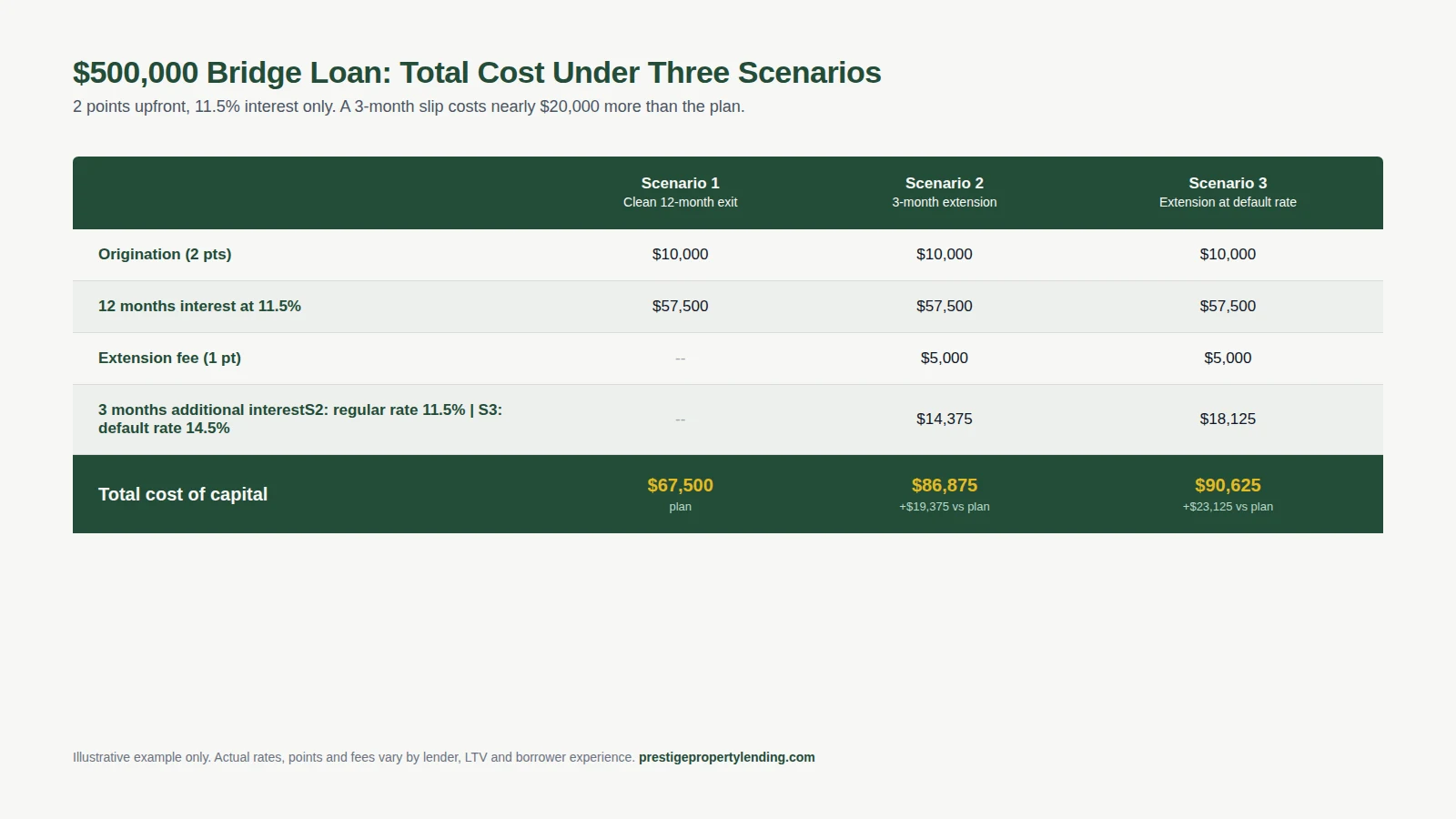
The clean 12-month exit costs $67,500. A 3-month slip to month 15 at the regular rate adds $19,375, bringing the total to $86,875. If those three extension months trigger the default rate at 14.5 percent, the total reaches $90,625: $23,125 more than the plan.
That spread is not an argument against bridge loans. It is an argument for conservative exit timelines. Model the 15-month case before you borrow, not after month 11. Use the hard money loan calculator to run your own hold period and rate scenario.
When a bridge loan is wrong for you
Your timeline realistically runs longer than 15 months. Bridge loans get expensive on a long hold. If your renovation and stabilization plan needs 18 to 24 months before the property is refinanceable, a bridge at 11.5 percent for 24 months plus an extension is a high cost of capital. A new construction loan with a longer built-in term may fit the hold period better. See the new construction loan program for ground-up builds that need 18 to 24 months of runway.
The margin is too thin to absorb a slip. If the deal shows $45,000 in net profit on a clean 12-month exit and the bridge costs $67,500 in that scenario, the math already requires precise execution. A single extension wipes out most of the gain. Bridge loans work best on deals where the spread between cost and exit value is wide enough to absorb variability.
You have no backup exit. “Sell it” depends on a buyer, an appraisal, and a closing timeline you do not control. “Refinance it” depends on the DSCR, the appraised value, and your financial position at a future date. Every bridge loan should have a plan B. If you cannot say in one sentence what you do when your primary exit fails, you are not ready to commit to the bridge.
You need this loan to produce a mortgage payment history. Business-purpose bridge loans do not generate a payment history that qualifies you for subsequent consumer mortgage products. If your end game requires that kind of documentation, talk through the full path with your lender before you take the bridge.

What to do next
Bridge loans are the right tool when the deal needs speed, when the property does not qualify for conventional financing, or when the business plan requires flexibility that a term loan cannot provide. The question is not whether they are expensive relative to long-term financing. They are. The question is whether the return on the deal justifies the cost of capital given a realistic exit timeline.
Review the bridge loan program page for what the application looks like and what loan sizes are available. To talk through a specific deal before committing, call 917-842-9982.
Common questions
What is a typical interest rate on a bridge loan for an investor in 2026?
Rates on business-purpose bridge loans have generally been observed in a range of 10 to 13 percent interest-only as of late 2026. The specific rate on any deal depends on LTV, borrower experience, property type, and loan size. Lower LTV and documented experience press the rate toward the lower end. A first-time investor on a higher-LTV loan will price toward the upper end. These are market ranges, not a rate sheet, and the rate moves with market conditions.
Is a bridge loan the same as a hard money loan?
The terms overlap significantly. Both describe short-term, asset-based, business-purpose loans that close fast. The practical distinction is mainly in how different lenders structure their underwriting: some lenders who call their product hard money focus heavily on the as-is property value, while a bridge lender may place more weight on the exit strategy and the borrower’s track record. From a borrower’s perspective, the payment structure (interest-only), points, and extension mechanics are very similar.
What happens if I cannot exit a bridge loan by the maturity date?
Most bridge loan agreements allow for one or two extensions at a cost of 1 to 2 points per extension period, for 3 to 6 months of additional term. You request the extension before the maturity date, pay the fee, and continue. If you cannot exit within the extended period and have not made other arrangements, the loan moves into default: the default rate applies, and the lender can begin foreclosure proceedings depending on the loan agreement. Contact the lender before maturity, not after, if your exit is at risk of slipping.
Can I use a bridge loan if I have a low credit score?
Business-purpose bridge loans place less weight on credit score than conventional loans, but the borrower’s financial profile is not irrelevant. Most lenders review credit as part of the file, and a very low score or recent bankruptcy can affect eligibility, particularly at better LTV and rate tiers. The property’s value, your experience, and your exit plan typically carry more weight than credit alone. Talk through your specific situation before applying.
Does a bridge loan affect my ability to get a DSCR loan later?
Not in a direct negative way. Paying off a bridge loan cleanly is a positive data point: it shows you executed an exit strategy. When you apply for a DSCR loan, the lender will want the property to show rental income or qualifying market rent, a current appraisal, and your liquidity at that time. The main timing risk is if the DSCR lender requires a seasoning period, typically 3 to 12 months of ownership or rental income, that conflicts with your bridge maturity date. Know the DSCR requirements before you set your bridge timeline.
Ready to fund your next deal?
Approval within 72 hours. Close in 5 to 10 business days.
Get Funding Now