Construction Loan Appraisal: How the Subject-to-Completion Value Works and Why It Often Comes In Below Your Budget
The subject-to-completion appraisal sets your construction loan amount before the building exists. How lenders order it, how comparables are selected, and what causes the number to fall below your budget.

The subject-to-completion appraisal values a building that does not exist yet. When it falls below your build cost, the gap is real cash you have to bring to closing. Here is how lenders use it to size the loan and what you can do before it is ordered.

The subject-to-completion appraisal sets your construction loan amount before the building exists. This post is for real estate investors only. It does not apply to homeowners financing a primary residence. For investors building spec homes, build-to-rent projects, and ground-up commercial deals: the appraiser receives your plans and hard cost budget, values a future asset against comparable sold homes, and produces a number that your lender uses to cap the loan.
When that number falls below your build cost, the gap is real cash you have to bring to closing. Most investors underwrite their deal using the cost-to-build as a proxy for value. The appraisal is the correction.
How a subject-to-completion appraisal works
Your lender orders the appraisal, not you. The appraiser receives a package: construction plans, specifications for finishes and fixtures, the hard cost budget, and sometimes a lot survey. They do not visit a finished building. They perform a sales comparison approach using closed sales of comparable completed homes in the area, then adjust those comparables for differences in size, bedrooms, baths, finishes, lot size, and location to arrive at what the subject property would have sold for if it were complete today.
The technical term is an “as-if complete” or “subject to” appraisal. The value is contingent on the property being completed in accordance with the submitted plans and specifications. Any material change to those plans after the appraisal is ordered can require a revision, which delays your draw schedule and can hold up your first disbursement.
The appraiser does inspect the site in person before delivering the initial report. They assess topography, access, utilities, surrounding uses, and location characteristics that affect value and that cannot be assessed from aerial imagery alone. During construction, draw inspections confirm completed work before each disbursement, but those are typically done by a separate inspection service rather than the same appraiser.
How the lender uses the appraised value to size the loan
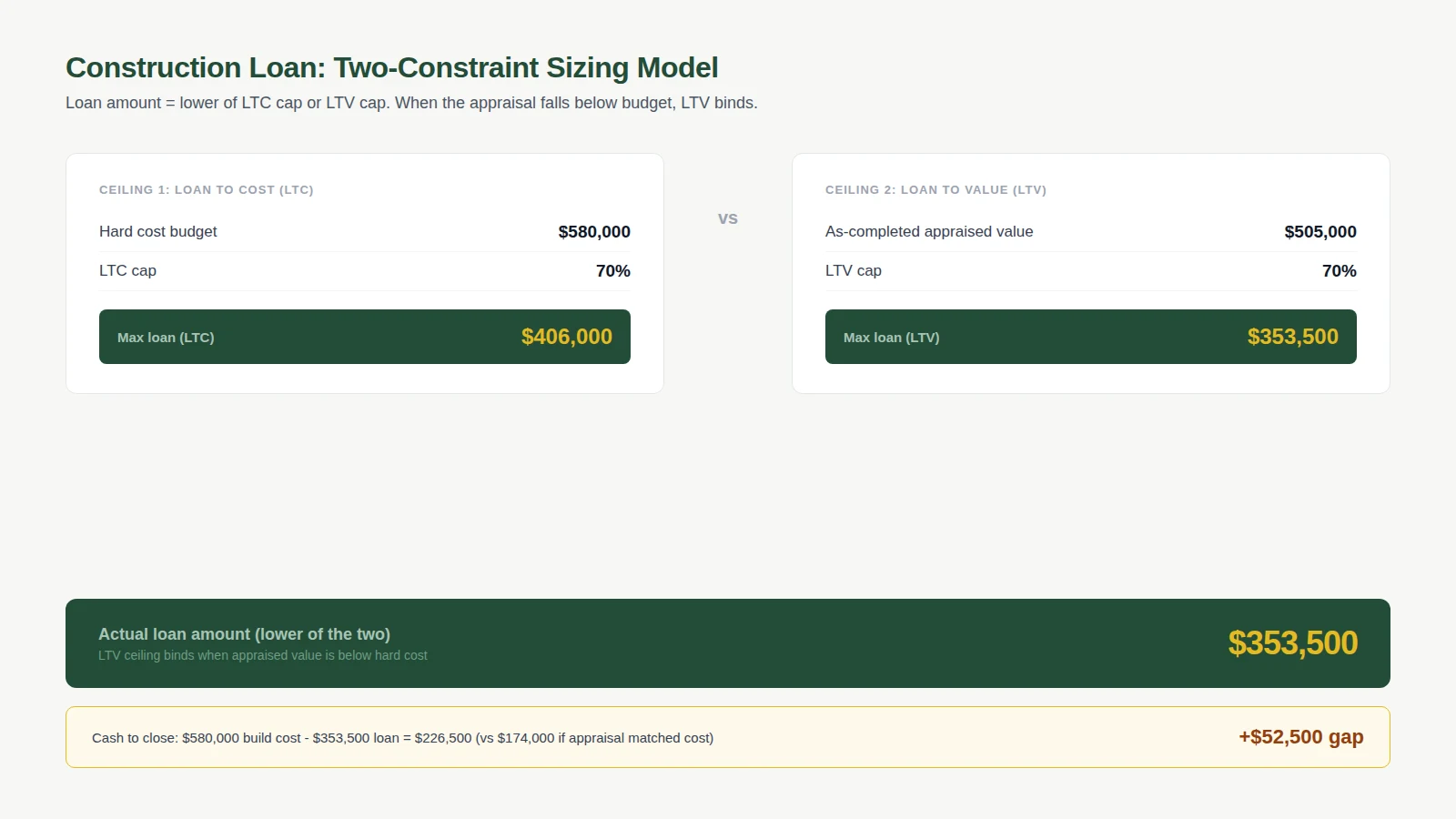
Construction loans are constrained by two separate ceilings at the same time. Lenders typically cap the loan at the lower of a percentage of the hard cost budget (loan-to-cost, or LTC) and a percentage of the as-completed appraised value (loan-to-value, or LTV). Whichever ceiling is lower determines your actual loan amount.
When the appraised value comes in below your build cost, the LTV cap binds rather than the LTC cap, and the loan is smaller than you planned. Here is a worked example at numbers that show why this matters:
| Factor | Amount |
|---|---|
| Hard cost budget | $580,000 |
| LTC cap (70%) | $406,000 |
| As-completed appraised value | $505,000 |
| LTV cap (70%) | $353,500 |
| Actual loan amount (lower of the two) | $353,500 |
| Cash you bring to closing | $226,500 |
If the appraised value had matched the build cost at $580,000, the loan would be $406,000 and you would bring $174,000. The appraisal gap in this example costs $52,500 in additional equity. That is the number most investors do not model when they underwrite the deal.
Want terms on a specific deal?Answer seven questions and get a decision in 72 hours.
Why the appraisal comes in lower than your budget
The most common reason: your finishes exceed what local closed sales support. Appraisers value real estate against comparable sales, not against cost. If the comparable sold homes in your submarket are tract-built with standard finishes, an appraiser cannot justify a higher value for your custom kitchen and premium tile even if that is exactly what you spent.
Thin comp pool. Appraisers prefer comparable sales within the past 12 months and within roughly one mile of the subject. In rural areas or low-volume submarkets, the appraiser may need to go back 18 to 24 months or expand the search radius to find anything usable. Older or more distant comps require additional adjustments, which introduces uncertainty and can produce conservative conclusions.
Gross living area above the neighborhood median. A 3,500 square foot home in a neighborhood where most homes are 1,800 to 2,200 square feet is an overimprovement. Appraisers adjust downward on gross living area once it exceeds what the market supports, because that extra footage does not add proportional value in the resale market.
Spec discount in an owner-user market. Some markets price completed new construction above resale, but in markets dominated by owner-occupants who bought resale, an appraiser may apply a spec discount reflecting the risk of buying before completion. That discount typically ranges from 2 to 5 percent and disappears if you have a presold purchase contract in hand.
What moves the appraised value and what does not
Structural and functional features carry more appraiser weight than interior finishes. An extra bedroom adds value that the comp grid supports. An upgraded tile package rarely does, unless the comp pool consists of other luxury builds. The table below summarizes what appraisers adjust for and what they typically cannot substantiate without comps to support it.
| Feature | How appraisers treat it |
|---|---|
| Gross living area | Adjusted dollar-per-sq-ft from comp grid; diminishing returns above neighborhood median |
| Bedroom and bath count | Adjusted from comp grid; typically $5,000 to $15,000 per bedroom/bath depending on market |
| Lot size and location | Adjusted from paired sales; corner lot or cul-de-sac typically adds 2 to 5 percent |
| Garage spaces | Adjusted from comp grid; typically $10,000 to $25,000 per space |
| Luxury kitchen or bath finishes | Minor adjustment only unless comps with similar finishes exist |
| Presold purchase contract | Eliminates spec uncertainty; can support a 3 to 7 percent premium over open market value |
What you can do before the appraisal is ordered
You cannot select the appraiser (the lender does that), but you can influence the input package.
Pull comparable sales yourself before the appraisal is ordered. Use MLS data or a local agent to identify what has sold in the past 12 months within reasonable proximity to your site at similar square footage. If the data supports your budget, you can present it to the lender as a comparable exhibit for inclusion in the appraisal order package. Appraisers are not obligated to use your comps, but they are required to explain in writing why they rejected any comp you supplied.
Keep finish specifications mainstream. If you are building in a market where the typical buyer paid $285,000 for a resale, your $45,000 custom kitchen will not appraise out. Match finishes to the top-performing comps in your market, not what you personally find attractive or what you have seen work in a different submarket.
Consider preselling before you build. A signed purchase contract from a qualified buyer eliminates the spec discount and gives the appraiser a data point that is more reliable than any comparable sale: an actual market transaction. Lenders typically increase the LTV ceiling by 5 percentage points on a presold project. On a $550,000 project, that is $27,500 in additional loan proceeds at no extra cost.
Use the ARV calculator to run your project before you submit for a loan. If your budget puts you above a reasonable as-completed value based on local comps, you either need to cut costs, adjust your comp expectations, or bring more equity. Doing that math before the appraisal is ordered is far less painful than finding out during underwriting.
For a full picture of how the draw process works once the appraisal is in hand, see the construction loan draw schedule guide, which covers how disbursements are timed against inspections and what causes draw delays that affect your carry cost.
When this loan is wrong for you
The subject-to-completion appraisal creates specific problems in certain project types. Be direct with yourself about whether you are in one of them before you apply.
Luxury spec in a mid-market neighborhood. Your finishes cost more than the market will pay. The appraiser cannot support the value from closed sales data, and no amount of negotiation changes that. The fix is either to match finishes to the market or to build in a neighborhood where the comp pool supports the product.
First build with no comparables within range. Rural sites, unusual lot configurations, and truly custom homes in low-volume areas leave the appraiser working with weak data. The result is wide adjustment ranges and conservative conclusions. Some lenders require additional comps or a second appraisal in these situations, which adds time and cost to the process.
Budget that leaves no cushion. A project where your equity depends on the appraisal coming in at exactly your build cost has no margin for a low conclusion. Plan for the appraisal to come in 5 to 8 percent below your budget on a speculative build and underwrite your deal accordingly. If the numbers only work at par, they do not work.
Spec projects above $2 million in secondary markets. The upper end of the comp pool in secondary markets is thin, and appraisers may need to go back two or three years to find comparables. This introduces uncertainty and often produces conservative conclusions at the top of the market. These projects are financeable through the new construction program, but expect more back-and-forth on the appraisal and budget extra time.
Common questions
How long does a construction loan appraisal take?
Most lenders order the appraisal immediately after receiving your plans and hard cost budget. The process typically takes two to four weeks from order to delivery, depending on appraiser availability in your market. Rural or low-volume markets may take longer because the appraiser needs more time to identify and analyze comparable sales. The appraisal is usually a critical path item, meaning the loan cannot fund until it is received and reviewed. Building two to three extra weeks into your close timeline is standard practice.
Can I dispute a low subject-to-completion appraisal?
Yes, through a process called a reconsideration of value (ROV). You submit comparable sales evidence that you believe the appraiser missed or underweighted, along with a written argument for why those comps support a higher value. The appraiser reviews the submission and either adjusts the value or explains in writing why they are maintaining it. ROVs succeed most often when the borrower can identify a recent closed sale the appraiser did not use. They rarely succeed when the argument is simply that the number feels too low.
What is the difference between an as-is and an as-completed appraisal on a construction loan?
An as-is appraisal reflects the current value of the property in its present condition, which on a raw land construction deal is typically the land value only. An as-completed appraisal reflects the projected value of the finished building assuming it is built to the submitted plans. Most construction lenders use the as-completed value to size the loan, because that is the collateral they are ultimately holding. Some lenders require both: the as-is value to confirm the land equity, and the as-completed value to set the total loan amount.
Does having a purchase contract change the appraisal value?
It can. A presold purchase contract from a qualified buyer is a data point the appraiser can reference directly, and it removes the speculative nature of the assignment. For true spec builds, the appraiser must estimate what an unknown buyer will pay at an unknown future date. A signed contract replaces that uncertainty with a real transaction, and lenders frequently allow a higher LTV ceiling on presold projects as a result. The contract needs to be arm’s length and the buyer needs to be qualified for this to carry weight in the appraisal.
What to do next
If you are preparing a ground-up project, the first step is to run the numbers before submitting a loan application. The ARV calculator gives you a read on where your as-completed value needs to land relative to your budget. If the math is thin, it is better to know now than after the appraisal is ordered and the clock on your rate lock is running.
When you are ready to discuss financing, the new construction loan program page covers how construction loans are structured, what the draw process looks like, and how to get to a term sheet. You can also call 917-842-9982 with specific deal questions.
Ready to fund your next deal?
Approval within 72 hours. Close in 5 to 10 business days.
Ready to fund your next deal?
Approval within 72 hours. Close in 5 to 10 business days.
Get Funding Now